

You’ve probably met plenty of people who are absolutely convinced of things that other people are just as certain are wrong.
Trump is a buffoon. Only Jesus saves. Democrats care for the country. All religions are scams. America never landed a man on the moon. Republicans are a “basket of deplorables.”
Climate change is a hoax. Anyone who denies climate change is ignoring the science.
Free-market capitalism works. Free-market capitalism must be abolished.
Suffering is a delusion of the mind. Your suffering stems from childhood trauma.
And so on.
How can two people look at much of the same evidence and come away with completely different understandings of what is true or real? What’s going on?
It’s one thing to draw conclusions and make claims. It’s another thing to explore whether those conclusions or claims can actually be justified.
I’m not talking about beliefs around things like what happens to your car tire if you keep driving on it when it’s flat, or whether your credit-card agreement says you’ll be charged a late fee if you don’t pay on time.
Those are claims that can be checked and verified from outside one’s individual beliefs or personal experience.
Things start to get more challenging when we posit claims about human nature, God, truth, political ideology, spiritual experience, or the ultimate meaning of an event.
In this kind of territory, the evidence often does not interpret itself, and fair-minded people can arrive at radically different conclusions.
When reasonable people sit at opposite ends of the spectrum around a given phenomenon, what might be the next step to move things forward?
One possibility is to look not only at what they believe, but at how they arrived at those beliefs, and whether the grounds for their conclusions hold up under careful examination. In real life, this process is extremely challenging.
In a recent conversation with someone I’ve known for a long time, I was surprised to discover just how far his convictions about God and truth extended beyond anything I had previously imagined.
Over a series of lengthy email exchanges, he emphatically told me that the framework he operates within regarding truth, God, and God’s providence cannot be proved false. No amount of alleged disconfirming evidence against that framework, he maintained, could invalidate it.
Not every framework works this way. Some leave room for being wrong. His didn't.
Lately, I’ve been encountering similar experiences with other friends. The subject matter might differ, but the underlying pattern is similar. Deep conviction gradually leaves less and less room for considering that the framework itself might be mistaken.
These days I’m less interested in arguing over whose conclusions or beliefs might be correct or true. What I am interested in is how those conclusions are being justified in the first place.
If a claim or belief cannot be independently verified, or if reasonable people disagree about what is true, what might that tell us about how well the claim is being justified?
This does not necessarily mean the beliefs or convictions are false. Nor does it mean they have not been meaningful or beneficial to the person holding them.
The larger question is whether the grounds for those beliefs are strong enough to justify the claims beyond that person’s own experience and interpretive lens.
I know something about this from the inside.
I used to understand reality through what might be called a providential lens, meaning I saw people, events, conflicts, and historical developments as part of a larger divine purpose unfolding according to God’s plan.
This worldview offered a comprehensive understanding of the meaning and purpose of my life, along with a newfound confidence that I might one day realize my deepest-held dreams and desires while taking part in God’s work on the earth.
However, at that time, if someone had asked me, “What can you point to that justifies your belief in this providential framework?” my answer would have largely been my personal experiences and what I regarded as the truth of the teachings espoused by the framework itself.
But what justified my confidence that my experiences and the teachings themselves were reliable evidence that the framework was true?
Could what I was personally convinced about, for whatever reason, be validated by someone from outside the world I was living in?
At the time, those outside my worldview regarded it as misguided, false, and dangerous. What I was seeing and what they were seeing were miles apart.
So where do we go from there?
If two people disagree about the meaning of the evidence, what would allow either one to say that their interpretation is better justified?
If we keep asking why someone believes what they believe, and then ask for the reasons behind those reasons, where does the chain of reasoning eventually end, if at all?
When do we finally arrive at something we simply accept as true, without asking for further justification?
And what happens when the reasoning begins to circle back on itself, when the framework is used to validate the authority behind the framework?
In my case, for example, I pointed to the teachings embodied in the framework as verification that the framework must be true. But in doing so, I was using the teachings to validate themselves, like someone claiming the Bible is the Word of God because the Bible says so.
But how much of what we call evidence is already being interpreted through the lens we bring to it?
For example, a while back, I watched a video testimony of someone claiming he died and went to Hell, where God showed him the terrible fate that awaits those who don’t believe in the message of the Gospel.
Another person might interpret the same experience as a psychological event. Another might regard it as a delusion.
And still another might see it as an experience whose meaning cannot ultimately be known.
None of this automatically tells us which interpretation is better justified.
What it does tell us is that disagreement can run deeper than the facts themselves.
It can reach into the assumptions, authorities, experiences, relationships, and interpretive frameworks we use to decide what the facts mean.
Perhaps the real work begins not with better explanations or answers, but with noticing when we've stopped letting evidence count against us.
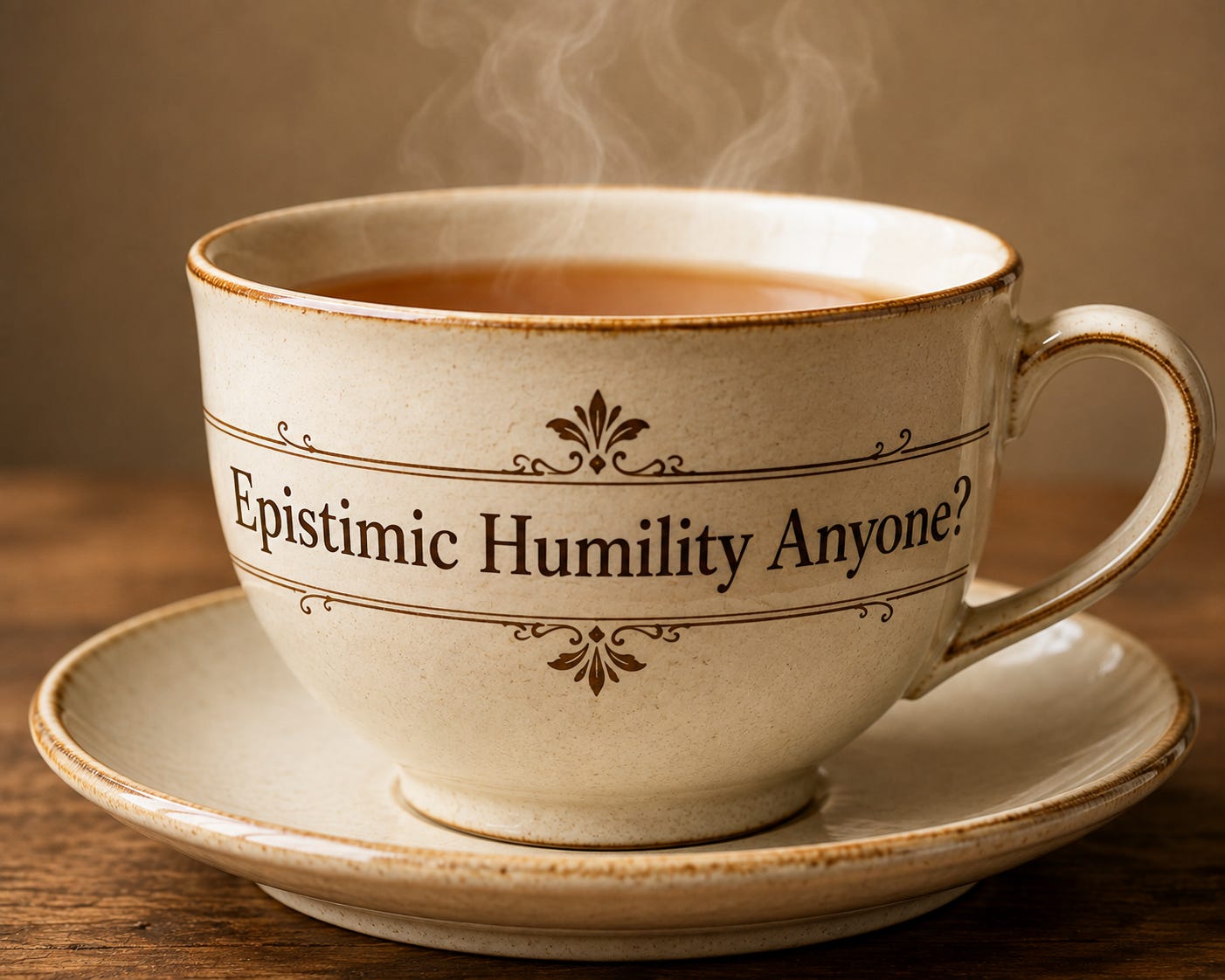
Anyone for a cup of epistemic humility, please?
While there are Universal Principles that govern life, how we interpret these principles will differ.
When I was a young child I absolutely without a doubt believed in Santa Clause and my whole world revolved around everything my parents taught me and lived by. As I grew up and matured (still in process) naturally my understanding of life in general evolved and deepened.
As we grow, hopefully we get focused on the essence of everything.
Perhaps the real work begins not with better explanations or answers, but with noticing when we've stopped letting evidence count against us.
This is well stated.