

Introduction
Since the 1990s, an increasing number of individuals in America referred to as spiritual but not religious (SBNR) are on a journey to craft what they sometimes refer to as a true authentic self. Estimates today put this number of individuals at around 60 million. The SBNR category is expected to continue to grow in the ensuing years.
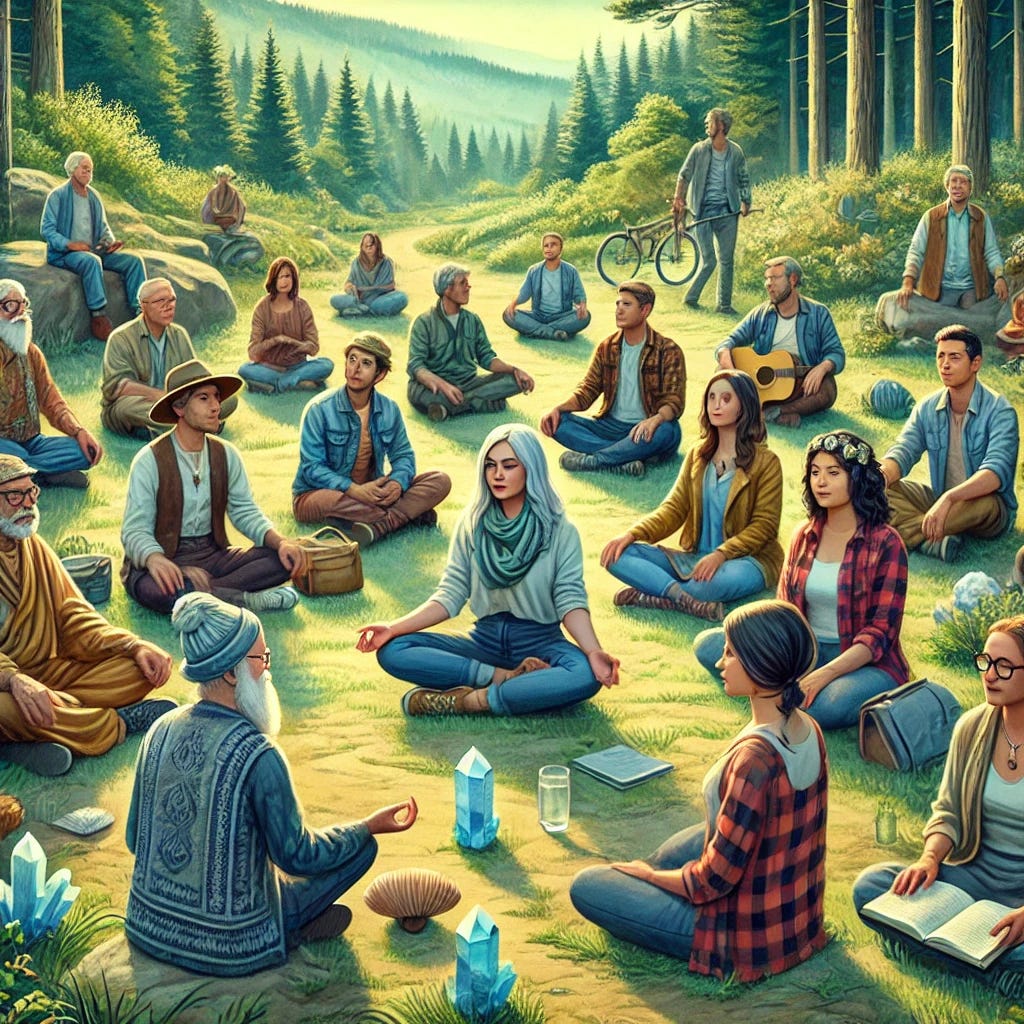
The spiritual but not religious individuals take the position it’s crucial to get in touch with and live by one’s innermost truth and convictions. But what exactly does it mean to live true to one’s innermost convictions? How are the spiritual but not religious folks trying to realize this goal?
If you are new to Spiritual Health Magazine and this is your first reading, you might say to yourself, “Who cares about this kind of stuff? You’ve got your life to live in this free country, so just go out and make something of yourself in whatever way you want, okay? Get a life!”
Spiritual Health Magazine sees the topic on the idea of self and how to actualize one’s true nature as very important in relation to one’s spiritual health. As noted in our August 15th edition:
"Spiritual health is a state of inner well-being that arises from a sense of purpose connected to something greater than oneself, and the ability to find meaning in life’s experiences.”
The affliction of multiple addictive behaviors
It doesn’t take long to recognize millions of adult Americans, and minors, are suffering from a variety of debilitating behavioral and substance abuse addictions. These addictions often cause great personal pain, loss, even untimely death, while producing an overall negative impact on the culture. In terms of spiritual health as defined above, millions of Americans are suffering and in need of prioritizing spiritual health in their life. Quoting again from the August 15th edition:
“Spiritual health is the most important dimension of human health. Yes, mental health, physical health, emotional health, social health, and psychological health are important and need to be properly nurtured. However, without spiritual health, improvements in the other domains of health might feel empty or lack sufficient depth.”
If you could sit with those suffering from addiction, they’d tell you they are not happy with themselves and want to do something to feel better about their life and future prospects. I’ve heard from personal acquaintances over and over again. So, the idea of paying attention to one’s concept about the self and how to best nurture it is vitally important.
The evolution on the idea of “self” in American culture
Until the 1960s in America, the idea of self and how to mold it was shaped primarily through the lens of the Christian worldview. In particular, the Protestant idea of a “fallen self,” meaning a self with a proclivity to be selfish, lazy, and rebellious towards authority, profoundly shaped the American family, community life, and societal expectations.
A defective self, according to the Christian worldview, is seen as something to be shaped in relationship to one’s social obligations. The church held the key institutional role to help shape individual morality and community behavior. Being a respectful child, good spouse, responsible parent, and displaying patriotism as a loyal citizen were an integral part of shaping this developing sense of self.
However, after World War II, the emergence of certain cultural shifts began to chip away at this predominant view of self, gradually altering how individuals understood their place and role in society.
Beatnik generation influence on the self
The Beatnik generation that emerged after World War II, a small group of influential literary writers and poets, promoted ideas of non-conformity, spiritual exploration and personal authenticity. These ideas flat out rejected American materialism and tended to undermine traditional values about faith, family, sexuality, and social obligations. Novels like Jack Kerouac’s 1957 On the Road, reflected an “I could care less” attitude about social norms and expectations operating in the 1950s post-World War II period.
The 1959 TV show Dobby Gillis depicted the first beatnik character, Maynard G. Krebs. He dressed like a slob, talked using the word “like” a lot, and often distorted or misused words in a sentence. He seemed to distain hard work and wanted to play around all the time. I can still remember my parents refusing to watch this show, saying it was a disgusting display of irresponsible teenage behavior.
The ideas promoted by the Beatnik generation of the 1950s would leak over into the 1960s through the counterculture movement.
Humanistic psychology influence on the self
The humanistic psychology of Maslow and client-centered therapy of Rodgers in the middle half of the 20th century, influenced the idea of the self and how it should be shaped. These disciplines reinforced the idea self-expression and self-actualization are essential pursuits in the shaping of an authentic self.
The theories about human nature proposed by Maslow and Rodgers did not take into account the negative aspects of the Christian view of self, that human beings are born with an inclination to be selfish and even brutish and must be kept in check by the moral and ethical teachings of the church, guided by religious authorities. They each delivered a more positive view on human nature; that human beings are naturally endowed with incredible potential and are responsible to perfect this human potential as much as is possible. This is the highest aim of human life.
Neither Maslow nor Rogers, nor the Beatniks, used the exact term “authentic true self” when discussing the importance of being “true to oneself” and “living in alignment with one’s personal values.” However, their ideas helped set the stage for further refinement on the concepts of self, authenticity, and personal empowerment.
Conclusion
Whatever the spiritual but not religious individuals are after in trying to be authentic and live true to their inner most convictions, it is clear from our brief historical review they are part of a decades-long reshaping of the concept of self that blossomed in the Post World War II era. This shift marks a significant departure from the teachings of Christianity and Judaism about human nature and how to actualize an authentic self in relationship to God.
What gradually emerges during this period is an increase in the number of available options to choose from to understand the self and actualize one’s human potential. This increase in available alternative options for personal development and self-actualization would expand more in the decades to come, once and for all upsetting the apple cart of the dominant Judeo-Christian worldview on self and human nature.
In future editions of Spiritual Health Magazine, we will explore further the evolving sense of self in America and how this evolution impacts spiritual health.
Until next week—here’s to your spiritual health!