

To survive and thrive, a whale in the open ocean isn’t required to name the body of water it swims in. But you and I are not that whale. To make sense of our lives, as we navigate the daily sea of cultural norms and expectations that we barely notice, we need to pause long enough to look around and begin to understand why life feels the way it does.
Has there ever been a time when you were walking down the street and suddenly realized your mobile phone was missing from the pants pocket where you usually keep it? This happens to me on occasion, and whenever it does, I’m always curious why it took me so long to recognize it was missing in the first place. We face a similar scenario when it comes to noticing what’s missing from the atmosphere of modern life.
Just like the phone missing from our pocket, some things can be missing from our lives long before we recognize their absence.
“Like what?” you might ask.
Here’s something we rarely pause to consider: in modern American culture, we no longer share a common story about who we are, why we are here, or what we belong to.
“What?” you might blurt out, in exasperation. “What are you talking about?”
An example from the evolution of the telephone in American life can help put this into perspective.
A child born in America in 2010 or later—today’s 14 or 15-year-old—has rarely seen a rotary or touch-tone phone outside of a museum, let alone used one. Yet these phones were an integral part of American household life from the early 1920s until around 2015. They are now largely forgotten, replaced by a new story, the mobile phone.
When these phones disappeared, a shared cultural experience in millions of American homes also vanished from view: reaching for the wall phone and lifting the receiver from its cradle, listening for a dial tone, tapping out a number on the touch-tone pad, or grabbing the phone extension cord and stretching it into the next room for privacy.
Every household shared this same experience. It was all part of the larger story of how we communicated and what it meant to be connected. As technology changed, the old story of how we communicated faded from view.
One day, we woke up to a new and different way of communicating and interacting at home and in public. Largely unnoticed, like when a sunset sky is bright red and yellow, and then, in the next moment, it has slipped below the horizon, a central piece of our common cultural ground slipped away.
Before we explore whether American culture once shared a common story that has now faded away and been replaced, let’s examine the current narrative circulating through the atmosphere of modern life, permeating our surroundings like an invisible weather pattern.
Imagine a landscape full of hundreds of “bubbles,” each containing a different person. Inside each bubble, the person’s environment consists of: headlines tailored to them, favorite social media feeds, personal goals, self-improvement plans, and anxieties.
Some bubbles are lightly bumping up against each other; others are drifting off into seeming nowhere. The spaces between the bubbles are fog-like, indicating the lack of a shared reality.
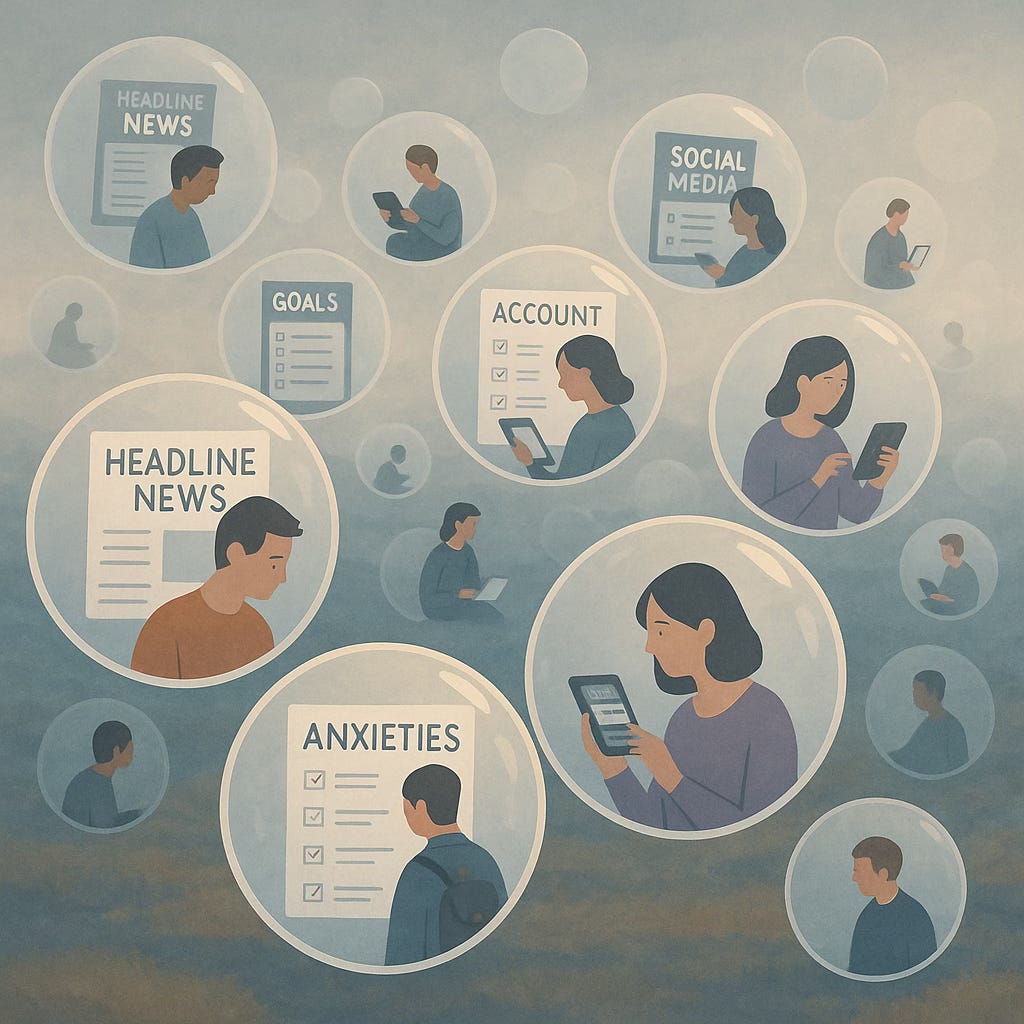
In today’s America, each person inhabits a personalized reality, shaped by algorithms, identity, preferences, and narrative. It’s a world of private worlds.
Our modern lives move like hundreds of self-contained bubbles, each one drifting through a shared forgetting of mystery, of sacred connection, and of a deeper story we once knew but no longer know how to name.
How did we arrive at this place?
If something here stirs you, don’t keep it to yourself! Leave a comment or reach out to me at: everydayspiritualhealth.com