

They’re gonna put me in the movies. They’re gonna make a big star out of me. We’ll make a film about a man who's said and lonely. And all I gotta do is act naturally.”— (Act Naturally. Russell/Morrison, 1963.)
Hmm…. Act naturally, as a human being… What’s that all about?
In the natural world, whether animals, birds, or insects, we observe patterned behaviors that scientists call “instinct.” It is a scientist’s way to try to explain how these seemingly unlearned behaviors are possible.
Let’s take the case of spiders. Spider researchers know spiders get no instruction on how to make a spider web. For example, experiments have been done where researchers take spider eggs and raise the hatchlings in separate containers with no mother, no contact with other spiders, and in environments where they cannot see any webs.
In a matter of a few days or a week or more, these spiders build complex, intricate webs made of silk that are stronger than steel by weight, more elastic than rubber, and light enough to float on air currents.
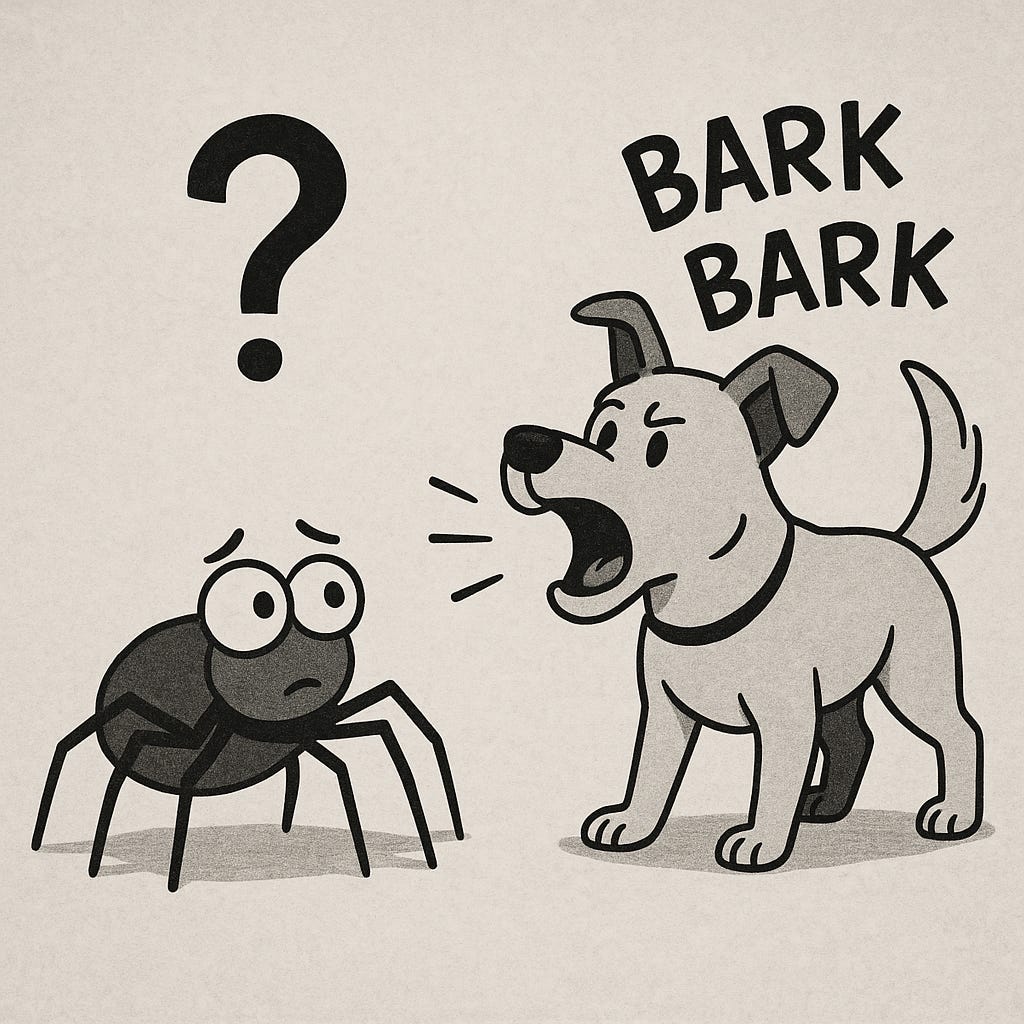
Somehow, a “something” inside the spider, its “nature,” causes it to weave its web, often in the dark. Every spider will act and behave the same, according to its nature. This is why you will never see a spider bark like a dog.
But scientists don’t know what that “something” is comprised of, calling the spider’s behavior “instinctive.” So the instinctive idea acts like a placeholder, a way for scientists to say there’s something that guides this behavior, without having to say they don’t fully know what that is or how it works.
Neuroscientist Mark S. Blumberg examines this complex and unresolved problem in his 2017 article, Development Evolving: The Origins and Meanings of Instinct.
“Invoking instinct to explain behavior is a way of closing inquiry rather than opening it. It is an admission of ignorance dressed in the language of understanding.”
Blumberg says that the simplistic notion of instinct as a fixed, inborn, genetically pre-programmed behavior is inadequate and misleading. Instead, a richer, more interactive developmental process, built up over aeons, is unfolding as an organism grows within its species-typical environment. Even the most automatic actions may be the result of a long evolutionary process that expresses itself through the body, nervous system, and the environment, according to Blumberg.
But why is life built like this? Why would evolution spend millions of years to give that spider the ability to weave its web?
And what about human beings? What is our distinctive nature? Are you curious?
Let’s say you grew up on a remote farm with no mechanical machines and never saw or heard of a car. One morning, you wake up and walk outside of your farmhouse onto the front porch, where you see a strange metal creature, shiny, enclosed, and resting on four round black legs in the front yard. Would you be curious about what it is, how it got there, and how it works?
Have you ever wondered why human beings appeared on Earth and why we act the way we do? What is this human nature that has evolved over millions of years?
Clamoring with noisy self-assuredness, animal behaviorists, neuroscientists, anthropologists, and psychologists try to tell us what our human nature is and how we acquired it. But no scientist, if honest, knows exactly how our human intelligence, awareness, morality, and social nature emerged from millions of years of evolutionary pressures.
The monotheistic faith traditions of Judaism, Christianity, and Islam assert that the deeper aspects of our human nature are derived not from accident or evolution alone, but from a “meaningful source beyond ourselves.” But what is this source, and where is it located?
Cultural-philosophical traditions such as Hinduism and Buddhism allow people to explore the nature of reality, suffering, consciousness, and human behavior, without a single creed or fixed set of beliefs, like in the Western religious sense.
Various African cultural traditions indicate that our human nature isn’t a fixed, programmed essence, but flows from the Creator through people, community, nature, and ancestors.
Perhaps the farm boy we spoke of a moment ago glanced at the car in his front yard, shrugged his shoulders, and moved on with his required daily tasks, starting with milking his herd of cows in the barn. The decision to examine or not the strange shiny object in his front yard is his to make, based on what he considers most important in life.
But you or I are not the farmboy. Something has appeared before us: the question of who we are and why we are the way we are.
If life has woven millions of years of developmental evolution to shape the patterns of all species, what has life been shaping in each of us that longs to be expressed, just as the spider cannot help but weave its web?
If this essay sparked a question or stirred something in you, I’d love to hear it. Add your reflections below.