

Our last essay ended with a question: whether the unease we feel is less about finding the right response and more about considering the larger framework within which we are trying to respond at all. This essay stays with that question, turning our attention to the framework itself rather than to any particular solution.
We often assume that we are living in a neutral reality, free from any shared story that once might have shaped how people understood themselves and the world. Yet the ways we make sense of life are rarely self-chosen. They are absorbed gradually, like a native language taken for granted, so familiar that it becomes indistinguishable from reality itself.
In our pluralistic world, we’ve absorbed the idea that meaning must be self-assembled, justified, and privately sustained. There is no longer a felt need to inherit any prior framework on how to live or behave in the world. German philosopher F. Nietzsche’s prized work, Thus Spoke Zarathustra (1883-85), captures this shift vividly, presenting a world in which inherited meanings no longer hold and the task of value-creation falls squarely on the individual. It is both a celebration of human possibility and an unflinching exposure of what such freedom requires. This modern-day shift inward to derive meaning and coherence in one’s life carries a particular weight, even when life appears to be going well.
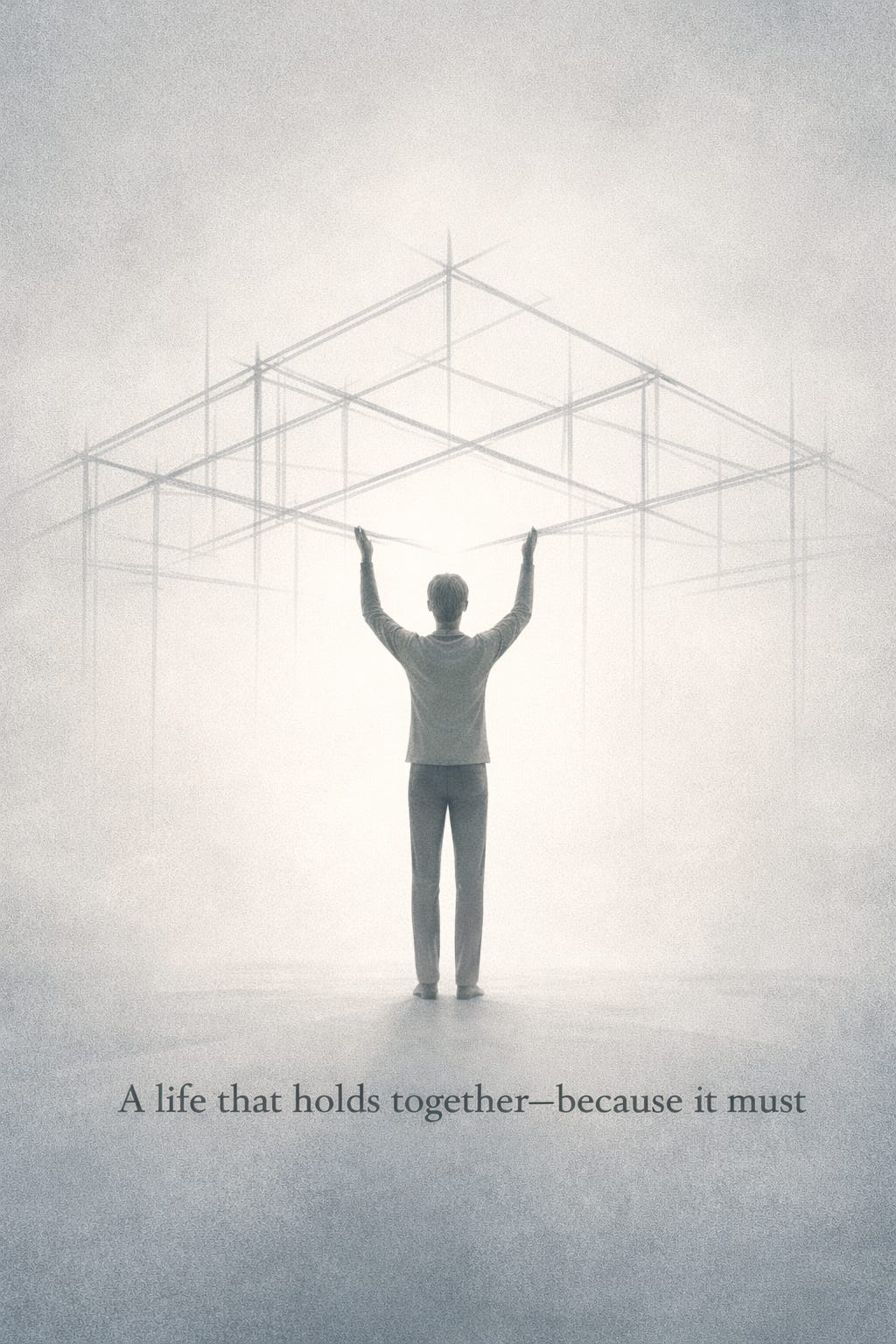
When meaning must be continually generated and sustained from within, the self is never fully at rest. Orientation becomes something to monitor, revise, and defend, rather than something quietly inhabited. Even when life appears stable, productive, or successful, there is an underlying vigilance at work, a sense that coherence depends on ongoing effort. Nothing collapses all at once. Instead, meaning must be continually tended, like a structure that holds only as long as it is actively maintained. This, we are told, is simply the price to be paid for the vigilance required to create and sustain oneself in a world now free of past dogmas, traditions, and superstitions.
This way of living is not a universal human condition. In many cultures outside the modern West, identity, responsibility, and belonging have traditionally been embedded within inherited social, familial, and moral structures that precede individual choice. One does not begin life by assembling a personal framework of meaning but by being claimed by relationships, obligations, and expectations that situate the self within a larger order.
While such arrangements carry their own tensions and costs, they spare the individual from having to invent coherence from scratch. The modern Western condition, by contrast, asks the self to stand alone first and orient itself later, bearing a weight that other cultures distribute across shared forms of life.
What makes this situation especially difficult is that we lack a shared language for distinguishing between meaning that is imposed and meaning that is received. Having rightly rejected dogmatic systems that claimed authority through coercion or fear, we have grown wary of anything that might orient us before we choose it. Yet in discarding those structures, we also lost confidence that a shared sense of reality could exist without domination. The result is not neutrality, but a quiet narrowing of our imagination, in which the self becomes the sole site of meaning-making by default.
This leaves us suspended between two unsatisfying options. On one side lies a return to inherited frameworks that many can no longer affirm in good faith. On the other lies a life of continual self-assembly, where coherence must be managed, defended, and sustained without rest. Pluralism offers freedom, but little guidance for how meaning might be received, shared, or carried together without collapsing into dogma. We are left highly skilled at choosing, but poorly equipped for inhabiting a world that can hold us in advance. What this raises is not yet a solution, but a deeper question: what would it mean to live within a fuller sense of reality again, one that does not demand belief we cannot affirm, yet does not leave us alone to manufacture meaning from scratch?
If the modern self has been shaped by the loss of inherited structure, then the task ahead is not repair or retreat, but reorientation. The next essay turns toward that possibility, asking what it might look like to recover a way of being in the world where meaning is not merely constructed, but encountered, shared, and sustained.