

In our last essay, we examined how our sense of self gradually fractured after centuries of being told that we must be responsible for crafting our own version of reality, that we don’t need to look to any outside agency for help, especially if such an agency leans toward a supernatural bent or any alleged forces beyond the natural world.
Many of us have now reached the limits of that promise. As a result, a subtle crack has formed in our sense of meaning and orientation, one that is easy to overlook at first but difficult to ignore once it is felt. This essay turns toward that moment, exploring ways modern life responds when the fracture becomes visible, and the impulse to seal it quietly takes hold. What follows is a look at six distinct ways we attempt to live with, manage, interpret, or move beyond this fracture once it can no longer be ignored.
In my bathroom, there is a medicine cabinet above the sink. While shaving one morning, I noticed some small cracks in the drywall by the mirror. As I stared at them, I wondered how long they had been there, since I’d not noticed them until this moment. Because it wasn’t doing any obvious harm, it was easy to dismiss. So I did. I went on with my busy day and quickly forgot about it.
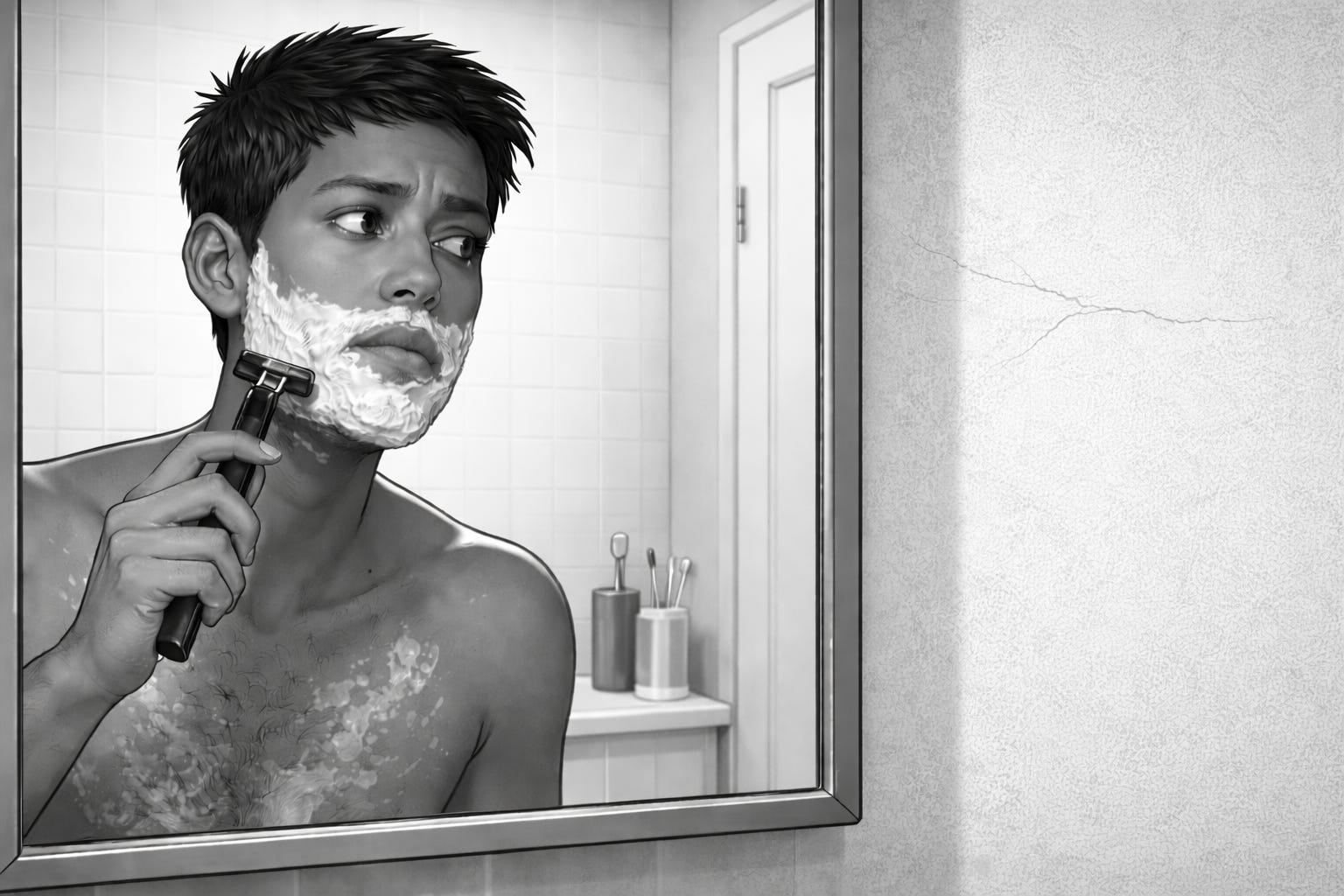
For many people, a momentary sense that something is off in their lives can arise and quickly fade, as life continues to function well enough. Over time, work, success, productivity, and forward movement provide sufficient meaning and orientation. Even if a sense of disorientation appears now and then, external validation through activity and accomplishment is enough to hold one’s identity intact, with no felt sense that something needs to be repaired. This response is reinforced by a culture that rewards productivity, achievement, and progress, which supplies enough external validation to keep the deeper questions of life at bay.
When I first began to sense something was off in the way I was living, I pushed it aside. I didn’t want to examine this feeling further, so I kept moving forward and ignored the unease, focusing instead on my major tasks and responsibilities.
Another response, rather than ignoring the cracks in the wall, is to quickly paint over them, without trying to understand what caused them, but to make the wall look normal again with minimal effort. It’s a reasonable response, especially if you don’t like home renovations or don’t want to waste time messing around with a bathroom wall.
Once the unease of an unsettled mind is felt, a common response is to find a way to calm it without wanting to know what lies behind it, or, in the case of the bathroom wall, what lies behind the crack itself. Life still functions. Work moves forward. Relationships are intact. Yes, the crack is noticed, but there’s no felt need to open up the wall to see further into the source of the problem.
A variety of contemporary wellness modalities operate on the assumption that distress is primarily a physiological or cognitive imbalance, rather than a signal of disorientation within a larger cultural or existential context. In this view, the cracked wall of unease can be smoothed over by providing the self with relief, calm, stability, and emotional breathing room.
Programs such as stress-management techniques, mindfulness practices, self-care routines, and wellness coaching are among many approaches that acknowledge something feels off and offer pragmatic, often helpful ways to restore stability. They allow life to continue with minimal disruption.
These responses are like painting over the cracks in the bathroom wall so it looks normal again, without needing to examine the underlying structure. They help manage the self more effectively, but leave unaddressed how to re-situate the self within a larger, shared framework of meaning, one able to provide genuine direction beyond continual self-repair.
As the practices and strategies I’d relied on for years no longer seemed as effective, I started to explore alternatives to stabilize my growing sense of discomfort and confusion. More than anything, I wanted to quickly recapture a feeling of safety and support that I felt was slowly slipping away.
Over time, for some people, reframing and self-management start to feel inadequate, as deeper, unaddressed needs keep returning. The crack begins to call for something more than effective techniques or sound explanations. At this point, there is a felt pull to look more closely, even if that pull is accompanied by hesitation or a resistance to getting too entangled in trying to make sense of what’s really going on.
Instead of quickly painting over the wall crack, time is taken to sand the paint down to the drywall and apply joint compound to the exposed area. Once it dries, it’s sanded again and repainted. Although the underlying cause of the cracks lies hidden, no attempt is made to explore further. The wall is assumed to be fundamentally sound.
At this level of response, specific program types help people to regain their footing, sense of direction, and a sense of meaning. Work around life purpose, values clarification, and restoring a sense of personal power all aim to help people find their way out of disorientation. For some, this also includes re-engaging with an institutional religion or becoming involved in a fringe or minority religious group, not necessarily out of conviction, but in search of structure, language, and a sense of cohesive belonging.
When I reached a point where I felt like there must be something wrong with me, I did something I’d never have considered before: I saw a professional counselor. My loss of confidence and sense of failure in my life orientation demanded more than a surface coat of paint.
There comes a point when fixing the crack through repair and management no longer feels like the right response. Instead, we look further, perhaps for the first time, at what the crack itself might be trying to reveal. Is there a structural issue with the wall itself that is causing the cracks to appear? The crack shifts from being a problem to solve to a signal of a larger issue we’ve not yet considered. In this light, our experience of unease or disorientation is no longer treated as something to eliminate or solve, but as an indication that the larger structure we’re living within may be under a hidden strain.
Programs and practices designed to help people step back from trying to fix, optimize, or master, but stay with uncertainty and listen to what the fracture is revealing, operate at this level. Contemplative traditions, silent retreats, therapeutic inquiry without guaranteed outcomes, and presence over problem-solving offer no quick wins and no clear metrics to measure results.
Four years ago, I attended a ten-day silent meditation retreat in the Vipassana tradition. No talking. No eye contact. Eight hours of meditation every day, with the first group session starting at 4:30 AM. I wasn’t looking for answers, but was curious to see how I’d respond to the experience of remaining present with reality as it is, without reaching for explanation, relief, or escape.
Up to this point, the crack has been treated either as a problem to fix within the wall or as a signal revealing something about the structure itself. At this stage, some people decide to open up the wall, exposing what’s going on underneath, to see what the exterior has been hiding from view. This is the point where the work moves beyond solutions and reflective inquiry into direct encounter.
The opening up to what’s been hidden is often marked by risk-taking, vulnerability, and exposure. It involves being acted upon, not just acting, allowing individuals to come into contact with forces larger than the self. Here, the work is no longer about fixing what feels broken or mastering oneself more effectively.
This response is marked by experiences and containers that deliberately open up the wall, allowing the individual to be in contact with forces larger than personal control or explanation. Meaning is not constructed or managed here, but it is encountered through vulnerability, risk, and surrender. The self is no longer doing the acting, but is being acted upon, altered, and addressed in ways that are unpredictable and cannot be fully contained.
Extended retreats, initiatory rites, depth-oriented therapeutic work, carefully held psychedelic experiences, wilderness solos, and contemplative disciplines can all function in this way when approached with care and seriousness. These modalities are united by a willingness to enter spaces where the self can no longer manage outcomes, but instead, must be opened, addressed, and reshaped by forces beyond its own authorship.
Two years ago, I found myself in a carefully contained setting where my habitual sense of self as manager and interpreter of events quietly failed. What followed was not understanding, but a sudden release of tears, along with involuntary shaking, sadness, and grief, suggesting a process happening through me rather than one directed by me.
What becomes clear at this level of engagement is that opening the wall does not, by itself, restore stability or meaning. Something essential has been touched, but how that encounter is held, interpreted, and lived with over time remains an open question.
Across these varied responses, it also becomes clear that modern life offers several ways to deal with fracture once it has been noticed. People are not sitting around in passive indifference. They are actively searching for ways to live in the aftermath of a shared story once largely carried by religious institutions, stories that no longer hold the imaginative or communal commitments they once inspired.
Some approaches downplay the fracture, while others attempt to explain or open it up for repair. Each approach has its appeal, and each can help in limited ways. Taken together, they also point to a deeper question: whether the unease we feel is less about finding the right response and more about considering the larger framework within which we are trying to respond at all. Is our task ahead about repair and management, or about re-orientation? That is the question our next essay takes up.
great topic great writing~!