

In the last essay, we examined how modern life requires us to become the sole arbitrators responsible for continually creating and maintaining our sense of well-being. We saw that even when life appears successful or stable, this demand often leaves us exhausted and anxious, with less freedom, not more. The essay concluded by questioning whether the problem lies in how fragmented adults repair their lives, or whether something more fundamental has gone missing in how we learn to stand in the world to begin with.
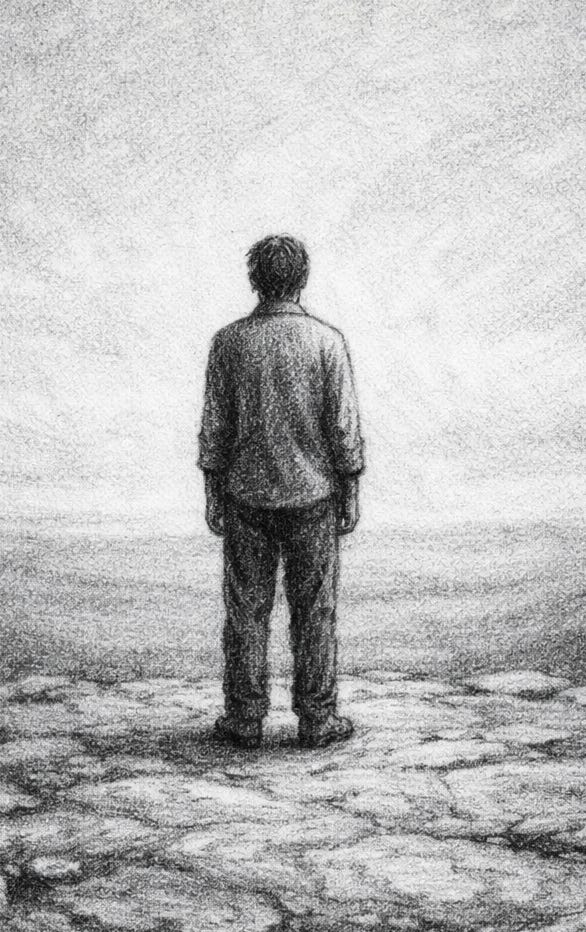
Is there a shared ground we can stand in that does not depend on a belief system, a worldview, privileged insight, or a set of propositions that demand agreement? If it is not a doctrine to be affirmed, a practice to be mastered, or a hidden truth accessible only through special insight, revelation, or experience, then what does this shared ground actually look and feel like?
In childhood, our experience of this shared ground takes shape before self-reflection. Babies, infants, and children learn what the world is like not through propositions or truth claims, but through the rhythms, responses, and atmospheres that surround them. Before a child can choose values or construct meaning, they absorb a sense of whether life is trustworthy, whether their presence is welcomed, and whether they belong somewhere without having to earn it. These early formations do not tell the child what to think, but they quietly teach how to stand.
When this early sense of standing is conditional or untrustworthy, it often goes unnoticed until much later in life. As adults, we interpret the resulting strain as a personal problem to be solved rather than a formative absence to be understood. We work harder on ourselves, refine our strategies, and seek insight, therapy, discipline, or meaning systems that promise coherence and security. Much of what passes for adult growth, then, is not transformation so much as repair, an ongoing effort to stabilize a sense of ground that was never fully secured in the first place. The self becomes an ever-present project because it was never allowed to rest as a presence that was already enough.
What this shared ground is, then, is not an idea to be grasped, but a condition already at work in us. It is the given capacity to remain present to life as it unfolds, to bear experience without having to secure it first with explanation or justification. This ground shows up as a quiet steadiness beneath our thoughts and emotions, a basic resilience that allows us to meet joy and loss, success and failure, without losing our footing entirely. It does not eliminate pain or difficulty, but it makes endurance possible without requiring constant self-defense. In this sense, the ground is not something we stand on so much as something we are already standing within, a sustaining context that holds life even when our interpretations falter.
What makes this ground genuinely shared is that it does not depend on agreement, belief, particular experiences, performance, or cultural alignment to function. People can stand within it while holding very different interpretations of the world, different stories, practices, and commitments.
Across religious, secular, and cultural differences, human beings still bear loss, uncertainty, love, responsibility, and time in remarkably similar ways. The ground operates not at the level of conclusions, but at the level of capacity, the capacity to remain present, to endure, to respond, and to carry life forward even when meaning is contested or unclear. Because it does not ask us to think the same thoughts or tell the same stories, it can quietly hold differences rather than erase them. In a pluralistic world, this kind of ground does not unify us by agreement, but by participation in the same fragile, sustaining conditions of being human.
A significant barrier to inhabiting this shared ground is the persistent human impulse toward rightness and distinction. Even practices that begin as sincere attempts to heal, awaken, or ground ourselves can quietly turn into markers of moral or spiritual superiority. Insight becomes a form of currency. Experience becomes a credential. Access, whether through religious belonging, specialized training, rare encounters, or costly practices, can start to function as proof of having arrived somewhere others have not.
At that point, grounding subtly shifts from something shared to something possessed. This is often the demarcation line. Practices may genuinely help stabilize, clarify, or open the self, but when they become the basis for status, authority, or exclusion, they no longer point beyond themselves. The shared ground gives way to hierarchy, and orientation once again becomes something one must earn, defend, or display.
Part of what complicates this search for shared ground is our collective exhaustion with how easily meaning hardens into tribal identity. Religious traditions that once offered orientation often became tools for exclusion, coercion, or moral superiority, and the damage they caused was real. In response, many learned to distrust the religious impulse itself, treating it as inherently dangerous or regressive.
But the vacuum left by this rejection has not made us less tribal, only differently so. Belonging still forms around identities, ideologies, and experiences, often with the same patterns of certainty, boundary-making, and dismissal of outsiders. The problem, then, is not that humans seek shared ground, but that we have become wary of anything that resembles it, even when its absence leaves us fractured and alone.
Having rejected the tyranny of abusive religious authority and power, we now find ourselves confronting a subtler tyranny, one in which meaning fragments into rival camps and orientations, and the self is left to negotiate belonging without any ground sturdy enough to hold us together. The freedom to choose without coercion or limits becomes the dominant refrain of modern life, at times resembling a kind of secular religious fervor.
When someone is no longer standing by constant effort alone, the change is rarely dramatic. Life does not suddenly become easier or more certain. What shifts instead is the constant bracing that once accompanied everyday decisions. There is less urgency to secure meaning before acting, less pressure to interpret every experience as evidence of success or failure. Responsibility remains, but it is no longer carried as proof of worth.
Standing within what already holds us does not eliminate struggle, disagreement, or loss. It does, however, change how those realities are borne. Failure no longer threatens total collapse. Difference does not immediately demand withdrawal or domination. Time feels less like a countdown and more like something that can be entered and endured. One still chooses, still acts, still responds, but not as though everything depends on getting it right.
This is not a higher state, privileged insight, or final arrival. It is a quieter way of inhabiting life, one in which meaning is not constantly assembled, defended, or performed. The self is still present, but it is no longer the sole load-bearing structure. Something else is doing part of the holding, even when we cannot name it.
Across this series, we have traced how modern life fractures the self, how we respond to that fracture, and how much effort goes into holding ourselves together once shared orientation dissolves. What emerges here is not another response to manage, but a different way of seeing the problem itself. The deepest question is no longer how the self can repair itself, but whether we have forgotten that standing was once something given before it ever became something achieved.
If the modern struggle has been shaped by the loss of inherited ground, then the work before us is not repair, mastery, privileged insight, or a return to what once was, but learning how to stand again within what has always already been holding us. This does not require agreement, belief, or special access. It does not ask us to be certain, only present. Nor does it require asserting superior truth claims or dismissing claims that do not align with our self-constructed views of reality.
Perhaps the simplest image of this shared ground has been with us all along. Long before we choose, decide, believe, or construct meaning, the human heart is already at work. It sustains life without instruction, agreement, or effort on our part. It does not ask whether we are ready, worthy, certain, or aligned. It simply beats, holding us in existence moment by moment. We do not manage it into action or earn its reliability. We learn to trust it by living.
Standing on ground we did not create will never feel triumphant. It feels quieter than that, more like a release from the need to keep proving, securing, or justifying our place in the world. Life still asks much of us. But when the ground is trustworthy, we no longer have to hold everything together by effort alone. We can finally begin, not by constructing meaning, but by inhabiting the life that is already here.
So, the next time you feel the familiar pressure to fix, secure, or explain your life, it may be worth pausing long enough to notice whether that urgency reflects a lack of insight or a deeper exhaustion from standing alone. What if nothing new needs to be added, and the invitation is simply to stop bracing and let yourself rest within the ground that has been carrying you all along, long before you knew how to name it?
A note for readers:
This seven-part essay series will soon be gathered into a seven-module exploration available on my Everyday Spiritual Health website. The essays you have read here form the narrative backbone of that work.
The modules are not designed as a program to complete or a system to adopt, but as a structured way of slowing down and staying with the questions we have been circling together, questions about meaning, orientation, disorientation, and what it might mean to stand in the world without having to construct everything from scratch.
More details will be shared in the coming weeks.
That is enough. Anything more would feel like marketing.