

Before turning to the deeper impact of the Enlightenment, it’s worth recalling where we’ve been already. In the first essay, we looked at the invisible atmosphere of modern life, the assumptions we breathe without realizing it.
In the second, we traced how those assumptions formed, following the long shift from the worldview that took shape in Western Europe after the fall of the Roman Empire. It was a world infused with sacred presence and moral meaning, gradually giving way to a modern framework organized around reason, autonomy, and control.
This third essay now examines the long-term cultural and psychological fallout of the Enlightenment.
Few today object to the claim that the Enlightenment period (roughly 1680-1800) transformed Western society, giving birth to modern democracy, individual freedoms, and human rights.
But would you be surprised to learn that its aftershocks have been more disruptive to our collective well-being than the destructive radioactive fallout unleashed by the above-ground nuclear blasts carried out by the United States and the Soviet Union in the late 1950s to the early 60s?
The European Enlightenment was not simply a shift from old religious and traditional ways of thinking to a new confidence in reason and science; it also reorganized the very framework through which people understood themselves, their purpose, and the meaning of the world around them.
Read on to understand how the physical fallout of nuclear testing eventually settled and decayed, while the fallout of the Enlightenment continues to radiate its invisible dust into every aspect of modern life.
To appreciate this comparison, it helps to recall how little was understood about nuclear fallout at the early stages of the Cold War.
The world had entered a new nuclear age, experimenting with a power whose full dangers and consequences were barely understood. Scientists at the time had only a partial understanding of what radioactive fallout actually was, and whether the particles released into the upper atmosphere would remain aloft, whether they would drift back down to Earth, and what damage the individual isotopes could inflict on human bodies, plant life, animals, or even bodies of water—and for how long.

Deadly Radioactive isotopes circling the globe
I’m not a scientist, but I did a little digging to understand how these repeated nuclear explosions affected the environment. Turns out that the fallout left behind was far more damaging than most people realize.
Six widely documented isotopes from above-ground testing spread through air, soil, water, and food chains, leaving measurable and long-lasting effects on both the environment and human health. Some, like Iodine-131, moved quickly through grasslands and dairy supplies, contributing to thyroid disease in children. Others, such as Strontium-90 and Cesium-137, settled into soil, water, and even the bones and teeth of human beings, raising cancer risks.
Longer-lived elements like Plutonium-239 lodged themselves in dust and sediments for decades, while Carbon-14 traveled the globe and entered plants, animals, and human tissue. Even short-lived isotopes contributed to early waves of contamination. Though only faint traces remain today, their environmental and biological footprints reveal just how far, and quietly, radioactive fallout traveled.
What once seemed to promise boundless energy and strategic advantage carried an unsuspected shadow: invisible clouds of radioactive dust swept up by high-altitude winds, circling the globe and eventually settling thousands of miles from the testing sites.
In hindsight, unleashing this power above ground revealed its consequences only gradually, long after the blinding flash of each explosion had disappeared.
The devastation was real and far-reaching. Yet even these consequences would prove temporary compared to the Enlightenment’s deeper, longer-lasting fallout, one that still shapes the way we think, choose, and understand ourselves.
To understand this deeper fallout, we need a closer look at the cultural atmosphere we’ve inherited from the Enlightenment. Its influence didn’t end with reshaping ideas or institutions; it seeped into the inner world of modern people in ways we rarely stop to notice.
And just as there are many ways to slice a pie — in quarters, halves, or twelfths — there are many ways to describe the consequences of this shift. The six I explore here are the ones I’ve felt most directly, patterns that slowly unraveled the world I thought I understood and that still shape the inner experience of countless others today.
As I look at these six effects, I can see the outline of my own journey, how I slowly drifted away from a world that once felt alive and whole, into a life that had grown flat, stale, and strangely solitary.
Perhaps you’ve felt some version of this yourself, not necessarily a collapse of belief, but a subtle loss of grounding, a loss of meaning, or a faint ache that ordinary life doesn’t quite add up the way it once seemed to.
These are the quiet signatures of the same fallout, expressed in different lives.
What has been lost in the long aftermath of the Enlightenment is not just a set of old religious or traditional beliefs, but a way of “being in the world.” It was a communal framework, a shared story that helped people understand who they were, what their lives meant, and how they fit into a larger cosmic order.
Reclaiming any sense of depth today doesn’t require returning to doctrines we can’t affirm or to systems that no longer speak to us. Instead, it calls for a renewed posture toward life, one that makes room for mystery, for presence, and for a common shared story that arises from lived experience rather than one imposed from the outside.
With that in mind, let’s turn to the first of the six effects, beginning with the quiet collapse of the story we once lived by.
Collapse of Shared Story
Before the Enlightenment, many people tried to live within a shared story that gave their lives a deep sense of purpose and belonging to something larger than themselves, a divinely ordered plan. When that framework gradually dissolved, individuals were left to construct their own meaning in a universe that no longer guaranteed significance or protection.
For the first half of my adult life, I believed I had been called to a special role within a divinely ordered plan. When that story gradually collapsed, the meaning that once held my life together fell with it, leaving me standing in a world that felt strangely unmoored and distant. This turned out to be the first ripple in a much deeper shift, one that began rewriting the entire structure of my inner world.
For those who remain inside a strong, coherent religious framework or deeply disciplined spiritual practice, this kind of collapse may seem unfamiliar or even unnecessary. But for many who have stepped outside the story they once believed in and trusted, this loss of cosmic grounding is often the first quiet fracture, a fracture that reshapes everything that follows.
Loss of Aliveness
When the old cosmic story began to fade, the world itself started to flatten. What had once felt vibrantly alive and charged with presence and mystery became silent, mechanical, and emotionally distant. Something vital had gone missing, and no amount of effort or explanation could bring it back.
After the larger story I’d been living fell away, the aliveness drained out of every aspect of life. What once felt intimate, bursting with meaning, became hollow, as if a large hole had opened up in the middle of my chest, where every ounce of enthusiasm for life seemed to disappear. This shrinking of aliveness set the stage for a deeper kind of loneliness, one that grew not from being alone but from feeling cut off from the world itself.
American singer-songwriter Don McLean captured this feeling in his 1972 number-one folk-rock hit American Pie, when he wrote about ‘the day the music died.’ The song tries to capture a moment when the innocence of American life seemed to crack in two.
That line has always stayed with me. Not because my crisis resembled his cultural moment, but because it captured the feeling of a sudden, irreversible shift, the sense that something vital had gone quiet inside me, and that the world I once knew would never return. McLean was naming a public rupture. I was living a private one, but the recognition was the same.
The Walled-off Self
As autonomy became a central theme to live by, individuals began to rely more on their own capacities and inclinations, and less on tradition or communal authority. This walled-off self came to be seen as its own source of meaning-making. People became isolated within their own minds, developing protective layers like skepticism and emotional detachment, closed off to penetration by anything “other-worldly.”
I recognized this walled-off self when my inner life began to feel distant, finding myself wanting to be as far away as possible from anything or anyone I perceived as trying to dictate how I thought, felt, or lived my life.
The Burden Starting Over
When the story you’ve lived inside falls apart, what follows is more than confusion; it’s the shattering of trust. Suddenly, the framework that once held your deepest commitments no longer feels reliable, and the task of rebuilding a meaningful life falls squarely and heavily on your own shoulders.
What felt like “liberation” in Enlightenment terms becomes a mandate for each person to chart their own way without the advantage of a compass pointing to true north. And when you must build or rebuild a life without a reliable compass, the self itself begins to fracture, setting the stage for the next, deeper layer of fallout.
For me, this meant owning up to a truth I never wanted to face: that in a very real sense, I had been sold a bill of goods. The world I once trusted with all my heart no longer held. And so I had to walk away. But this was not just about me. I was married and raising a family when this collapse occurred. My sense of self and of the future suddenly found itself without a trusted framework, and I shuddered at the thought of how this unraveling might ripple through my marriage and my children’s lives.
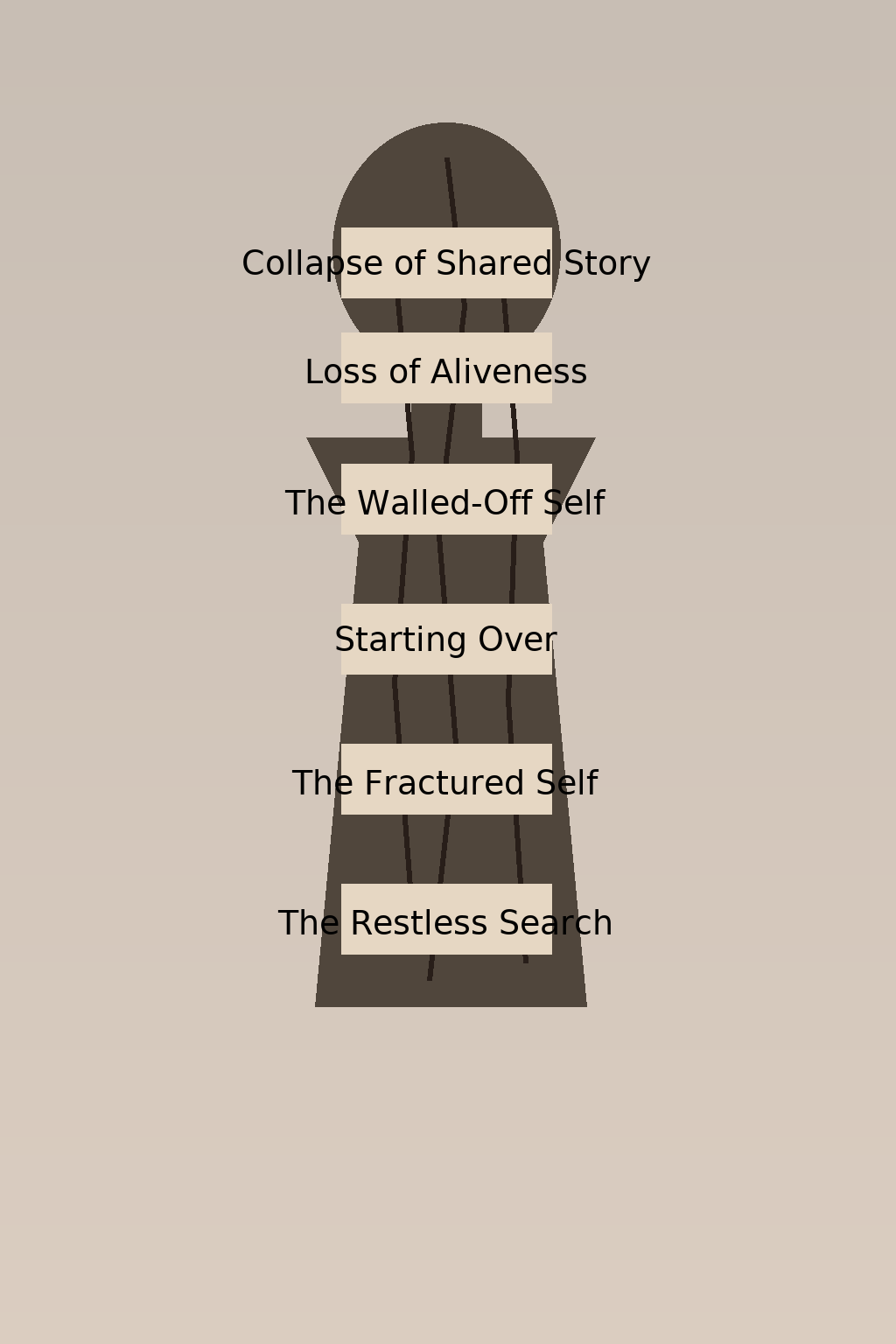
The Fractured Self
When the shared frameworks that once held identity in place erode, the self becomes increasingly fragile and internally conflicted. Without a stable narrative to live inside, modern individuals often experience themselves in fragments, being pulled between competing roles, values, and expectations.
Enlightenment autonomy promised human freedom and prosperity, but it also left people responsible for holding themselves together in a world no longer offering a unifying center.
In my own life, the collapse of the outer story quickly turned inward. The energy that once drove me began to ebb away, leaving a quiet hollowness where confidence and clarity had been. And as that inner structure weakened, a restless search took hold, a need to find something capable of restoring depth and direction.
The Restless Search
Once the self loses its sense of cohesiveness, a new and distinctly modern restlessness begins to take shape. Without a shared story to inhabit or a trusted point of orientation to follow, we become wanderers, moving from idea to idea, system to system, practice to practice, hoping to recover and reclaim some sense of meaning or depth, beyond the reach of anything purely rational or self-constructed.
The Enlightenment promised clarity through autonomy and individual freedom. Yet an unintended legacy is a perpetual searching, an ache that keeps us looking for something we can no longer name yet cannot live without.
I felt this restlessness take hold in me. After the collapse of what once anchored my life, I found myself searching for something that could ground me, like a floor under my feet to walk on. I moved through ideas, books, practices, and possibilities, hoping that one of them might rekindle the depth and purpose I had lost. But every path seemed unable to settle the ache inside me. What I was really searching for, though I didn’t have the words for it then, was a place to stand, something trustworthy enough to hold the weight of my life. Gradually, I realized my restlessness could not be resolved by adopting a new system or set of ideas, but by recovering a different way of being in the world altogether.
If the Enlightenment stripped away many of the old certainties, it also exposed a deeper truth: we cannot live well without some sense of meaning, connection, or orientation.
The six fallouts I’ve tried to describe here illustrate how this loss continues to shape our inner and outer lives, often without our awareness.
The question now is what might be recovered, if anything.
In our next essay, we’ll examine some key responses to this fractured condition we find ourselves in today.
The cosmic fracture-the lack of grounding. You capture this so well. Have you read Man's Search for Meaning? Something tells me you probably have. How does one email you these days?
Brilliant and captivating from the first page!