

In our previous essay, we exposed the burden of having to build meaning alone, a burden placed on us by a modern insistence that the self must generate its own orientation without any shared structure to rely on. This essay turns that insight in a different direction. Rather than focusing on how adults repair their lives after collapse or loss, it asks a more unsettling question: what if much of our later struggle arises because we were never taught how to stand in the world to begin with, and only discover this after the consequences of missteps, pressure, and quiet disorientation force a reckoning?
The relentless demand for total self-authorship, the kind Friedrich Nietzsche gave voice to, and the kind that quietly shapes modern lives from an early age, can be exhausting and isolating. Over time, the effort required to keep meaning intact begins to feel less like freedom and more like fatigue.
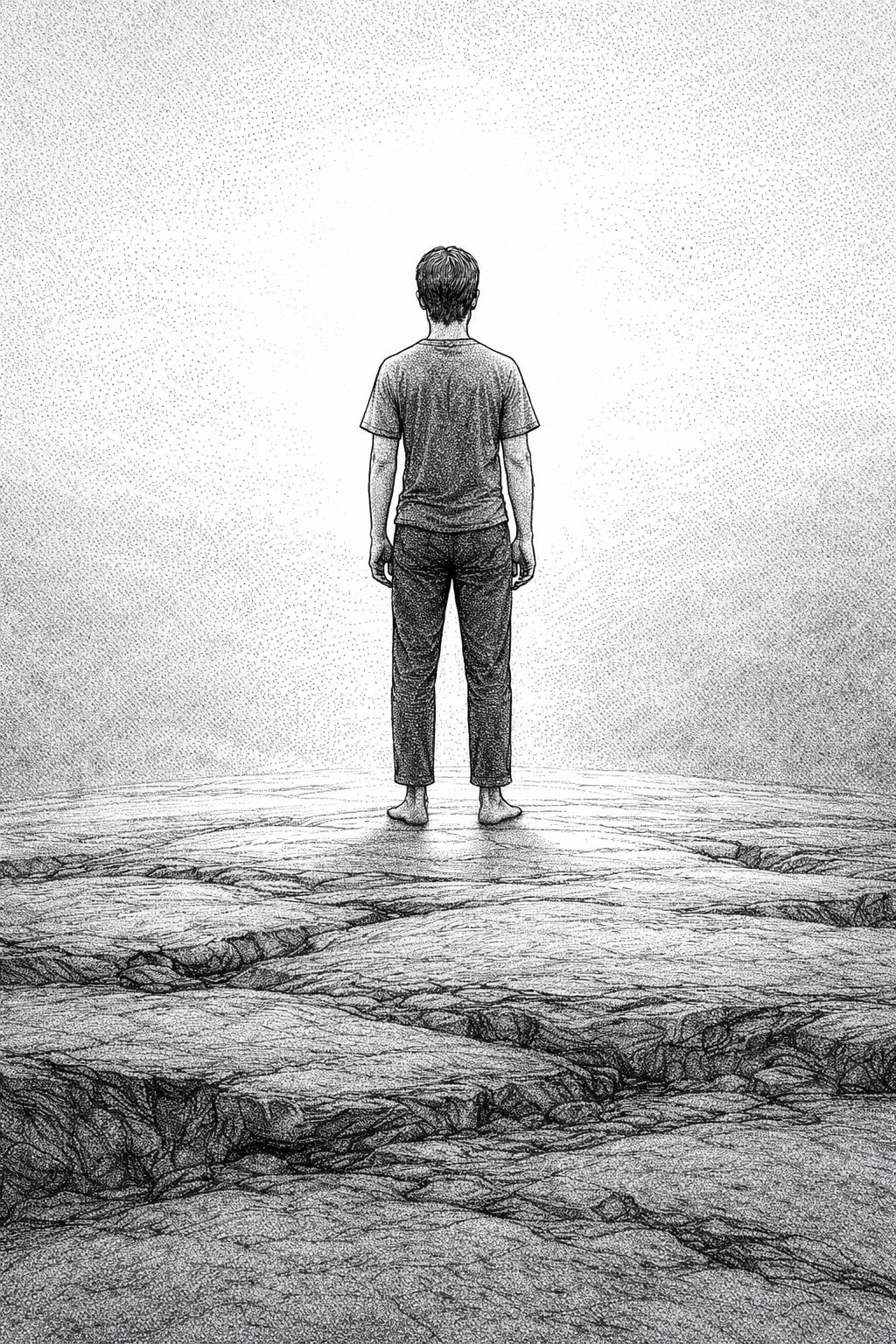
But what if the problem is not simply fragmentation, or the absence of the right response to it, but something more basic: how people are first oriented to live within a sense of meaning that does not begin and end with the self?
If orientation is something we absorb long before we know how to examine it, then the question is not merely how fragmented adults recover meaning and grounding, but how people are first taught to stand in the world at all. Long before beliefs are chosen or frameworks questioned, we learn by osmosis what claims our attention, what demands performance, and what quietly goes unanswered.
I have seen a different form of early orientation up close. When my wife’s nephew came to the United States for middle school and high school, he struggled deeply during his first few years. Much later, he told us how isolating and overwhelming that transition had been. Yet there was one thing he never questioned: he did not want to disappoint or embarrass his parents.
That obligation was not something he reasoned his way into or chose after reflection. It was already there, quietly shaping how he endured the experience. He cried in private, gritted his teeth, and made it work, not because it was easy, but because he knew where he stood. This kind of early formation carries its own costs, which are real and should not be minimized. Still, it reveals what it means to be oriented by something that precedes personal choice.
We are not born into the world only to carve out a life according to our own inclinations, preferences, or capacities. Long before choice, repair, or reorientation become conscious tasks, we are already being invited to stand somewhere. A world receives us, not as a blank slate to be engineered, but as a place with contours, rhythms, and claims that precede our approval or disapproval. Orientation, in this sense, is not something we invent after the fact, but something we learn to inhabit. The ground was already there before we knew we needed it.
From the very beginning, we breathe in and out Earth’s atmosphere tens of thousands of times a day, long before we are capable of noticing, choosing, or questioning what we are breathing.
What this suggests is that our deepest struggle may not be how fragmented adults repair and ground themselves after the damage is done, but how we are first taught to stand in the world at all. Modern life assumes orientation is something we assemble later, under pressure, after losses and missteps force us to take stock. As a result, much of what we call meaning becomes a form of continual repair, managing fractures that might never have needed fixing if the ground beneath us had been trustworthy from the start.
Yet this raises a more fundamental question: whether there is a way of standing that does not originate in self-construction, but in something already given, something we step into rather than invent. A way forward that doesn’t try to recover a lost past or impose another doctrine. The next essay turns toward that possibility, asking what it might mean to stand on ground we did not create, and to be oriented by what precedes choice rather than by what must be endlessly maintained.
Deep thoughts for sure. Are we born broken, or just without ground beneath our feet? What would different feel like, look like and be like? I like to think a parent's unconditional love makes the difference in a child's life, but sadly, that's not always the case.