

As the traditional Judeo-Christian worldview and truth claims continue to lose their relevance in providing support for life fulfillment, meaning, and connection, the American do-it-yourself (DIY) spiritual freelancer model is increasingly seen as a viable alternative.
To satisfy one’s spiritual hunger, advocates of this DIY approach draw from a seemingly endless well of non-traditional wisdom paths: mind-altering drugs, meditation, somatic modalities, coaching, therapy, psychology, music, and self-help.
Does the DIY spiritual model support a spiritually rich life and society more effectively than the once widely accepted cradle-to-grave religious models, despite their inherent flaws?
The strength of the spiritual freelancer model is its access to freedom and flexibility in the pursuit of truth and self-understanding. There is no requirement to adopt a particular belief system or truth claim.
One need not pledge commitment to a particular group or submit to a prescribed approach to how one should live, think, feel, and behave—one hallmark of the three monotheistic religions of Christianity, Judaism, and Islam. There’s no existential concern about the meaning of death or where one might or might not end up once separated from their mortal coil.
Without the pressure to conform to a given authority figure, sacred text, or proscribed set of behaviors, it’s easier for the spiritual freelancer to explore alternative points of view and integrate them into one’s idea of life fulfillment.
Freelancer spirituality allows a lot of room for personal healing, transformation, and honest self-expression, but can easily slide into loneliness, disconnection, and spiritual disorientation.
The promise of personal autonomy can feel intoxicating and empowering. No creeds to conform to, no beliefs to proclaim, no hierarchy to report to, and no rigid dogma to swallow. (I ain’t got to be under nobody’s thumb—nohow!) Still, the DIY model reveals a spiritual fragility susceptible to serious challenges.
Imagine lighting a candle in a house with no walls. The flame burns brightly. It is real and heartfelt. But seeping in like rainwater through cracked roof tiles, the winds of doubt, grief, exhaustion, and distraction begin to blow through on all sides.
With no protective communal shelter, no shared mutual practices, common language, or sacred container, the flame flickers, hovering between being completely smothered and desperately fighting to stay upright.
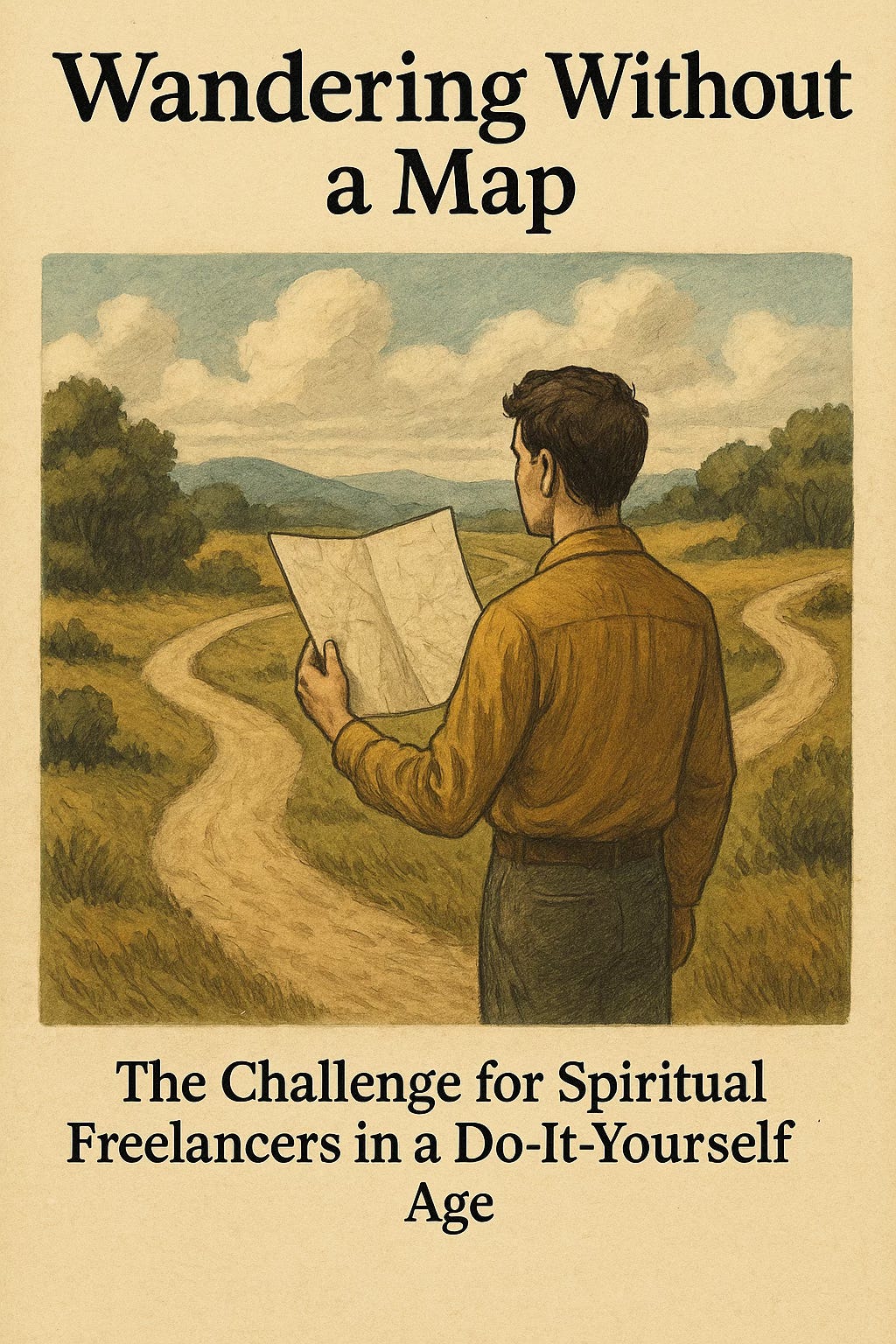
The spiritual freelancer must create, sustain, initiate, and do everything on their own. Over time, the initial warmth of the candle becomes harder to maintain. There’s no built-in cycle to return to when you are grieving, tired, distracted, or spiritually dry. This can lead to burnout, inconsistency, and a nagging sense of drifting, unanchored, like that candle in a house with no walls. It can be like navigating with a map that has no clear paths to follow.
But is it any better within the walls of established religious communities and traditions? What is their strength?
Unlike the spiritual freelancers, the walls of religious traditions maintain stability and continuity through shared community and recurring spiritual patterns, which help support people through life’s inevitable ups and downs. You’re not alone in your hardship or glory, grief or joy—in the loftiest sense of religious life.
Ironically, the walls of religious communities can also be fertile ground for disconnection, loneliness, and spiritual disorientation.
For the first half of my adult life, I was immersed in a faith tradition that spoke with certainty about who God is, what God wants, and how we are to live. It was a faith loaded with words, imagination, and intensity.
For a time, this faith tradition provided me with a deep sense of purpose, intentional community, and clear direction. In fact, I met my future wife in this religious community, which was a totally unexpected happening, especially since I’d given up all hope of ever finding someone who would want to spend the rest of their life with me.
But this community also required me to stay in a space that gradually could no longer hold the fullness of my evolving experience. I began to sense that all religious teachings and claims about truth, God, and how the world works are simply a story—nothing more, and nothing less. One experience in particular led me to this realization.
When the news broke in our community that a highly respected and admired married couple with several young children was getting a divorce due to infidelity, I was shocked. The husband, in a high leadership role in the community, constantly talked about the need for us to have strong marriages and raise faithful and honorable children. How could this happen? I asked myself.
This man seemed to me to be saying and doing all the right things in his life. As it turns out, he wasn’t doing as he was saying. This one incident alone clearly helped me see that no matter what one purports to believe in or claim as the truth, such claims and beliefs cannot take the place of one’s lived experience. What one does and how one acts is more powerful than any exclusivist claim to truth or teaching on the right way to live or what to believe.
Eventually, I needed to move beyond it. Not because I lost faith, but because I discovered that faith is more vast than any single story, tradition, truth claim, revered figure, sacred book, belief system, spiritual experience, or institution.
I don’t regret those years. They formed me. They showed me the hunger people have for belonging, meaning, and transcendence, and I’ve integrated those years into my journey. So, I am aware of the value of traditional religions and the benefits they offer.
Spiritual freelancers who’ve yet to be deeply involved with a traditional religious path cannot possibly know what they have to offer, beyond a surface-level understanding.
Before I committed to a dedicated religious path, I considered myself a seeker for truth and understanding. Raised in the Catholic Church faith, my folks had designs for me to one day become a priest. But when I hit middle school, sports and girls became my religion. By the time I graduated from high school, I’d all but given up on organized religion, without ever having immersed myself in its teachings or practices beyond sixth grade. You can learn more about those years by reading my first published essay on Substack
Paradoxically, after I moved beyond the confines of the religious path I’d been dedicated to for decades, I once again found myself walking the path of a spiritual freelancer. So, I know this path too—what it has to offer, and what its limits are.
As a now-again spiritual freelancer, I dabbled here and there for spiritual nourishment and growth. Yoga, meditation, spiritual books, seminars, and constant study and learning on a variety of subjects occupied my mind and heart.
At times, it was hard to keep momentum, to keep up with the new rituals and practices I adopted into my life. In my former faith community, I had lots of like-minded people around me to help reinforce the same rituals and practices. Doing it on my own proved far more taxing and difficult than I’d expected.
So, where do we go from here, in the uncertain space between the old spiritual maps of religion and the new, unmapped terrain spiritual freelancers are carving out?
For many, this moment is marked by both opportunity and ache. We’re freer than ever to seek, mix, question, and redefine what a meaningful life looks like, but many are quietly suffering under the weight of too much freedom, too little structure, and no overarching philosophy of life to help bind them together with something beyond the self.
People long for connection but lack a consistent, shared rhythm. They seek transformation but find themselves overwhelmed by the sheer volume of options—like going to your neighborhood drugstore for toothpaste and staring blankly at the shelf with forty-five different kinds of toothpaste to choose from! They want to go deeper but don’t know where to start or how to return when they’ve lost their way.
We don’t need to retreat into rigid belief systems, unless we want to, nor do we need to wander alone, on a hit or miss path marked by stutters, stops, sudden changes, and potholes.
What we need now is something rooted but open, trustworthy but not controlling, a spiritual language and set of practices that help us navigate meaningfully through the shifting terrain of modern life.
This essay is the beginning of a larger unfolding, both in my own life and in something I’ve been quietly building. It’s a project called Everyday Spiritual Health. It’s a space where I bring together years of reflection, practice, questions, and resources for those who still long for depth and presence in their life.
If what you’ve read here resonates, you’re invited to explore more, stay connected, and if it feels right, support the work at everydayspiritualhealth.com. It’s early, it’s honest, and it’s being built in real time, with care and an open heart.
You explained that so well...the line we navigate between our individual pursuit of faith and our community experience which can be supportive or suffocating, depending.