

Human suffering has been around at least since someone, long ago, in one of the oldest stories in the Western tradition about shame, loss, and loneliness, tried to pass the blame to someone else for their lapse in moral judgment.
Suffering appears in every human culture and every generation, although no two people experience or carry it in quite the same way. We can count on experiencing some form of emotional, physical, or existential pain in life.
Long before I had any clear notion about what suffering was, I already knew what it felt like to place mine before someone I believed could receive it.
Every Saturday afternoon from 4:00 PM to 5:30 PM, local Catholic churchgoers would line up in the aisle, one behind the other, facing the confessional box at the back of the church. Sometimes the line extended toward the middle of the church, and at other times, just a few people lined up.
Occasionally, my Nana would take me. Other times I’d go with a playmate, and I’d also go by myself. The whole thing was part of what you did on Saturday afternoon. Most of us who showed up knew each other, although occasionally I wouldn’t recognize one of the older people waiting in line.
Standing there, I mostly looked straight ahead, eyeing the confessional entrance to see who was entering and leaving, often guessing how long each person stayed inside talking to the priest.
Entering the confessional box was an ordeal. The less than fifteen-foot walk from the pew aisle to the confessional door felt like a mile. As I approached the wooden entrance door, I’d go over in my mind what I was going to say and confess. I’d ask myself: Did you forget anything? Are you sure you want to tell him your deepest secrets this time?
From what I can recall, the confessional compartment was about three or four feet wide, about the same depth, and maybe six feet high. It always felt much bigger to me, though, as I slowly opened the door and stepped inside. Maybe because, aside from a small crucifix on the wall, lit by a tiny, blurry, soft red light just above it, the room felt totally dark.
I’d always open the door slowly because sometimes it creaked, and against the dead silence of the church, any creaking sounded like a loudspeaker blaring to my hyper-attentive ears.
Once inside, making sure the door was closed, I’d kneel on the small, narrow, padded wooden ledge fixed low to the floor. The kneeler was positioned in front of a small, screened window in the partition separating me from where the priest sat on the other side.
With my knees resting on the padded kneeler and my body upright, my face landed roughly level with the small covered screen in front of me, close enough to speak quietly through the opening without needing to lean in or raise my voice.
The priest never turned to directly face me. Through the mesh screen I could only make out his profile. His face was angled toward the front of the church, as if he were listening not to me, but through me, to something else, even though I was speaking directly to him.
Nana had told me once that the priest wasn’t really the one listening to my confession, but that he was standing in for Jesus, who would always love me and forgive me for any sin.
Whatever I said to the priest, according to my Nana, he would carry it to God on behalf of Jesus. She encouraged me to see the priest not as a normal man, but as someone far larger, who already knew what I was going to say and who was ready to forgive my sins and love me regardless of what I had done.
Sometimes it seemed like I was kneeling there forever before the priest slid the mesh screen curtain open, casting a little more light into my compartment. He was also listening to confessions from someone on the opposite side of the booth, alternating between the two of us. The longer I waited, the more nervous and self-conscious I became.
I couldn’t hear the other person’s confession as I knelt there, but the muffled voice of the priest did reach my ears, without my being able to make out what he was saying.
When the mesh screen curtain finally opened, I’d speak first, staring at the priest’s profile, wondering if he recognized my voice. “Bless me, Father, for I have sinned. It has been one week since my last confession.” I do confess here that, on occasion, I’d have to say it had been two, three, or more weeks!
The priest always responded, “Go ahead, my child.”
One Saturday, during confession, I decided to tell the priest that one of my sins was throwing hard-packed snowballs at passing cars in front of the church earlier in the week. I think it must have been the last sin I uttered to him because I can remember an awkward pause hanging in the air for a moment. Then, suddenly, he asked, “Are you a good shot?” His voice felt more playful than usual.
I felt a surge of electricity through my body at this shocking, out-of-the-blue question. I wriggled, contorting my body from side to side. My face quickly felt hot with embarrassment as my mind raced to come up with an answer.
“Ugh…I guess I’m pretty good,” I said softly.
I honestly don’t remember much else about what happened after my answer. It likely ended in the usual way, with the priest assigning specific prayers for my penance, followed by his absolution: “I absolve you from your sins, in the name of the Father, and of the Son, and of the Holy Spirit.”
After reciting my prayers, sometimes quickly, other times more reflectively, in the same pew I’d sat in before confession, I’d step out of the church into the normal, noisy world. I often felt relief and a sense of cleanliness, as if I’d been given a new lease on life, another chance to be good and not disobey God’s rules for being an upright Catholic boy.
Decades later, after my understanding of God had evolved many times, I found myself in a very different place.
Unlike my mostly voluntary trips to the confessional on Saturday afternoons, carrying relatively minor sins to be gently absolved by the local priest, this time I arrived at the office of a family counselor carrying something much heavier. I felt overwhelmed by what I saw as my grave moral failures as a father and husband.
The fifteen-minute drive from my apartment to the counselor’s office felt like I was descending into one of Hieronymus Bosch’s paintings of tortured, agonizing souls in Hell.
Back in high school, in 1969, I’d bought Deep Purple’s third album largely because of its cover, a detail from the Hell panel of Hieronymus Bosch’s The Garden of Earthly Delights, filled with contorted, deformed, and tormented human bodies. I’d never heard of Bosch before, but I was so fascinated by the grotesque imagery that I had to buy the album.
I must have stared at that cover a hundred times as a teenager without ever really considering its unsettling implications. Now, decades later, gripping the steering wheel on my way to a stranger’s office, the image rose up uninvited, its tormented figures suddenly accompanying me on the drive.
By the time I trudged up the sidewalk and entered the building where the counselor’s office was located, I had little hope that a meeting with a man I’d never met could do much to lift the heaviness I was carrying.
The counselor, John, directed me to sit in the faded green sofa chair across from his desk. I stared at the worn seat cushion, permanently molded by the countless people who had sat there before me, and wondered, “Did everyone who sat in this chair for the first time feel as confused and hopeless as I do right now?”
I remember very little of what I actually said to John that day, or how he responded as I tried to explain what was happening in my family. I do remember telling him something about my faith background. He said he had counseled other members of my faith community before, but I didn’t believe him. At the time, we were discouraged from seeking counseling outside the faith, so his claim didn’t make sense to me.
That only added to my caution about how much of myself I wanted to reveal. I didn’t know what John believed about God, or whether he believed in God at all, and at that point in my life, that mattered greatly to me.
I was sitting across from a stranger, wondering what he could offer that my faith, my prayers, and my relationship with God had so far been unable to provide. As our session drew to a close, John asked calmly, “Jack, have you ever had any thoughts of suicide?”
After I assured him that, because of my faith, suicide was not an option, he walked over as I stood up, wrapped me in a bear hug, and said, “You’re going to be okay,” as he patted me on the back. I felt my body relax as his words sank into me, even though my mind couldn’t believe them.
“I’ve sat in that chair just like you did today, okay?” he said reassuringly as he walked me to the door.
When I got outside, I felt relieved that I’d gone through with the session, but I knew I wouldn’t and couldn’t come back again. A man’s reassurance was not the same as receiving God’s approval and forgiveness, at least not as I understood it back then.
A lot of water has passed under the bridge since I walked out of John’s office that day.
New relationships and some first-time experiences have given me a window into very different ways people understand and respond to suffering these days.
One of those windows opened when I was introduced to a coach who works with entrepreneurs and business leaders. Reading through his website and listening to one of his leadership seminars, I found myself lingering over the language he uses to describe how he works with clients.
Deep self-awareness. True essence. Limiting beliefs. Profound inner work. The wisdom of the body. Authentic connection to yourself. Your deepest values. Your inner landscape.
The words were familiar enough. I had encountered variations of them many times before in conversations and in the expanding worlds of coaching, wellness, healing, and personal growth. I had also explored some of these ideas and practices in my own life, including spending ten days in silence at a Vipassana meditation retreat, observing my breath, bodily sensations, and the seemingly endless movement of my own mind.
I wasn’t encountering this language as an outsider. What struck me this time was something I hadn’t paid much attention to before. It was where all those words seemed to be pointing.
The person who feels stuck, unfulfilled, disconnected, or anxious is invited to turn inward, become more aware of what is happening within, listen to the body, uncover what may lie outside conscious awareness, and discover something more authentic beneath the surface.
But what does it feel like to be suffering and be told to look within? What exactly am I looking for? How will I know when I’ve found it? And what happens when what I encounter inside myself isn’t wisdom or clarity, but more confusion?
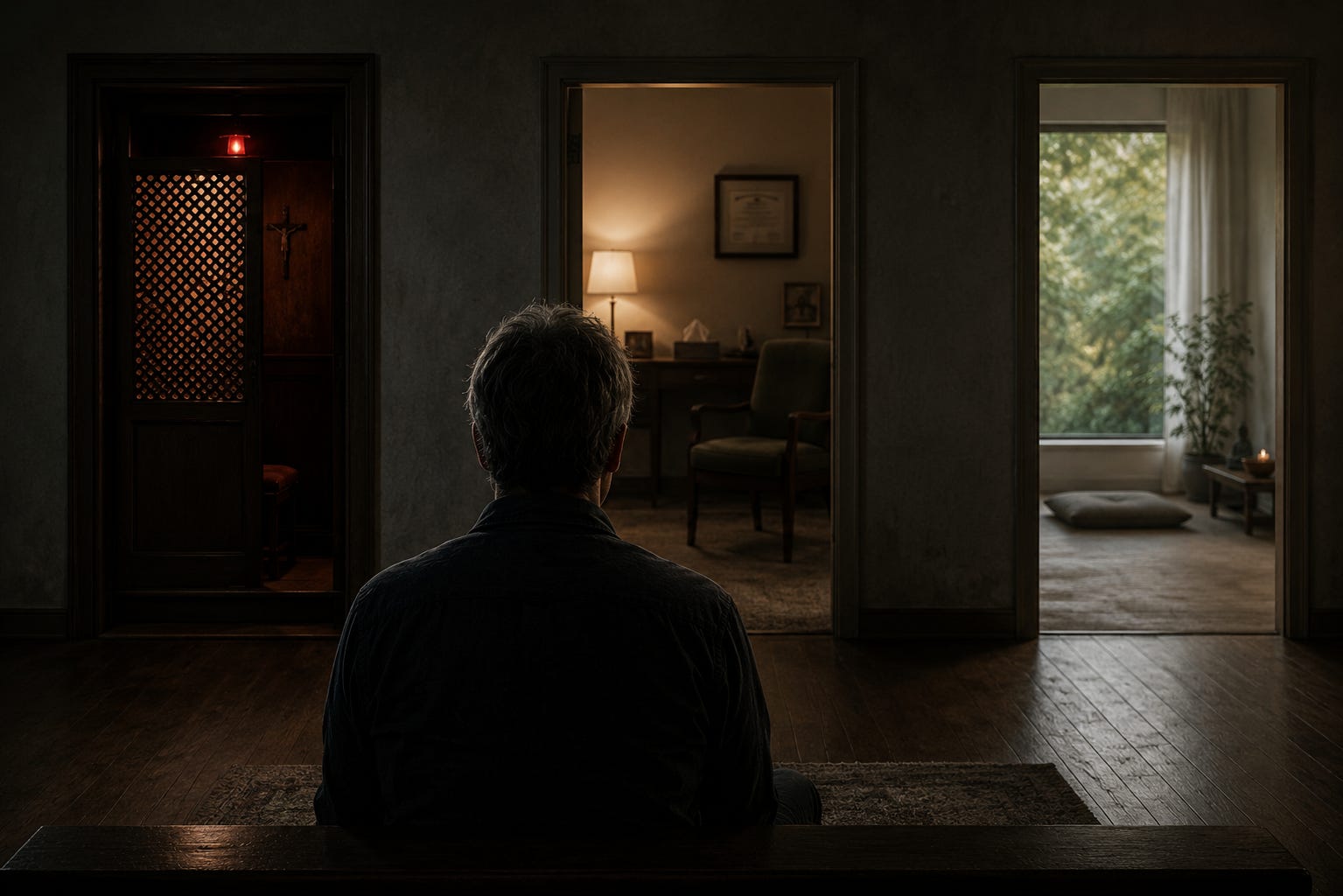
Looking back across these different encounters, I am struck less by which approach offers the better answer than by where each one directs us when suffering arrives.
As a boy, I brought what troubled me before God.
Years later, overwhelmed by problems I could no longer resolve through faith alone, I reluctantly carried them into another man’s office.
Today, much of the language surrounding wellness, healing, and personal growth invites us to turn inward, toward the body, the inner landscape, and resources assumed to already be there.
Suffering has followed me through all three worlds. What has changed is where I have looked for an answer.