
Where Did We Come From, and Where Are We Going?
Reflections on living

Do you know where you came from and where you’re going?
Anyone who says they’ve got the definitive answer to this question is, if you’ll pardon the expression, full of that something that sometimes comes out of you in a big, dark and heavy lump.
Let me say up front that I used to think I knew, beyond a shadow of a doubt, the answer to this question.
My certainty rested on unprovable metaphysical assumptions about the nature of the cosmos, the nature of human beings, and yes, that three-letter word with a capital G, God.
Back then, I assumed there was a God as explained to me in my parents’ Catholic tradition. God, as a reality, was a given.
I held for decades the belief that life was inherently meaningful because God, as I understood Him, created all things, was interested in my life, and would always be there to watch over me.
Just because my beliefs rested on assumptions that cannot be proven or disproven doesn’t mean those assumptions were meaningless.
Have you ever experienced being held by a power or force, or whatever you want to call it, in such a way that every second of your life overflowed with joy and a “peace that passeth all understanding”?
To try and put this experience into words, I’d say it’s like eating your favorite ice cream, recalling a beautiful sunset, and quietly drifting off into a peaceful sleep, while somehow knowing you are an integral part of everything that IS, all at once.
I have a different kind of certainty now, the certainty of uncertainty. A different kind of holding, the holding that comes from letting go of any definition of what’s holding.
Yes, I’ve listened to the anthropologists, believers, materialists, and others offer their particular answers to this question. Bless them all for giving it the old college try.
Many of us want concrete answers about most everything, even the toughest existential questions.
I know what evolution says. I’ve read enough to trust that it explains, remarkably well, how the human form arose from earlier forms.
But the question of why there is form at all, or a universe capable of producing form, is a different question altogether.
When we say form, what are we referring to?
The human form isn’t only something described in textbooks or traced back through fossil records or DNA, is it?
Perhaps the deeper question isn’t simply how the human form emerged, but what makes this human form possible to appear?
Before we ask where we are going, we might first pause before the fact that we are here.
Recently, I stumbled upon the story of the Inca girl, La Doncella, discovered by archaeologists in 1999, fully clothed and remarkably preserved on Llullaillaco, a 22,110-foot volcano on the Argentina-Chile border.
According to known Inca history, this teenage girl was offered to the gods as part of the Inca ritual of capacocha, to secure the empire’s favor, protection, and success.
This aspect of the story is fascinating in itself, but I was drawn to something beyond her selection as a ritual sacrifice.
Looking at photographs and watching short video clips of La Doncella enclosed in a glass display case, I found myself mysteriously drawn to her.
Sitting there in still-colorful but faded ceremonial garb, with her long dark hair, well-preserved skin, and seemingly serene facial expression, I found myself unable to look away.
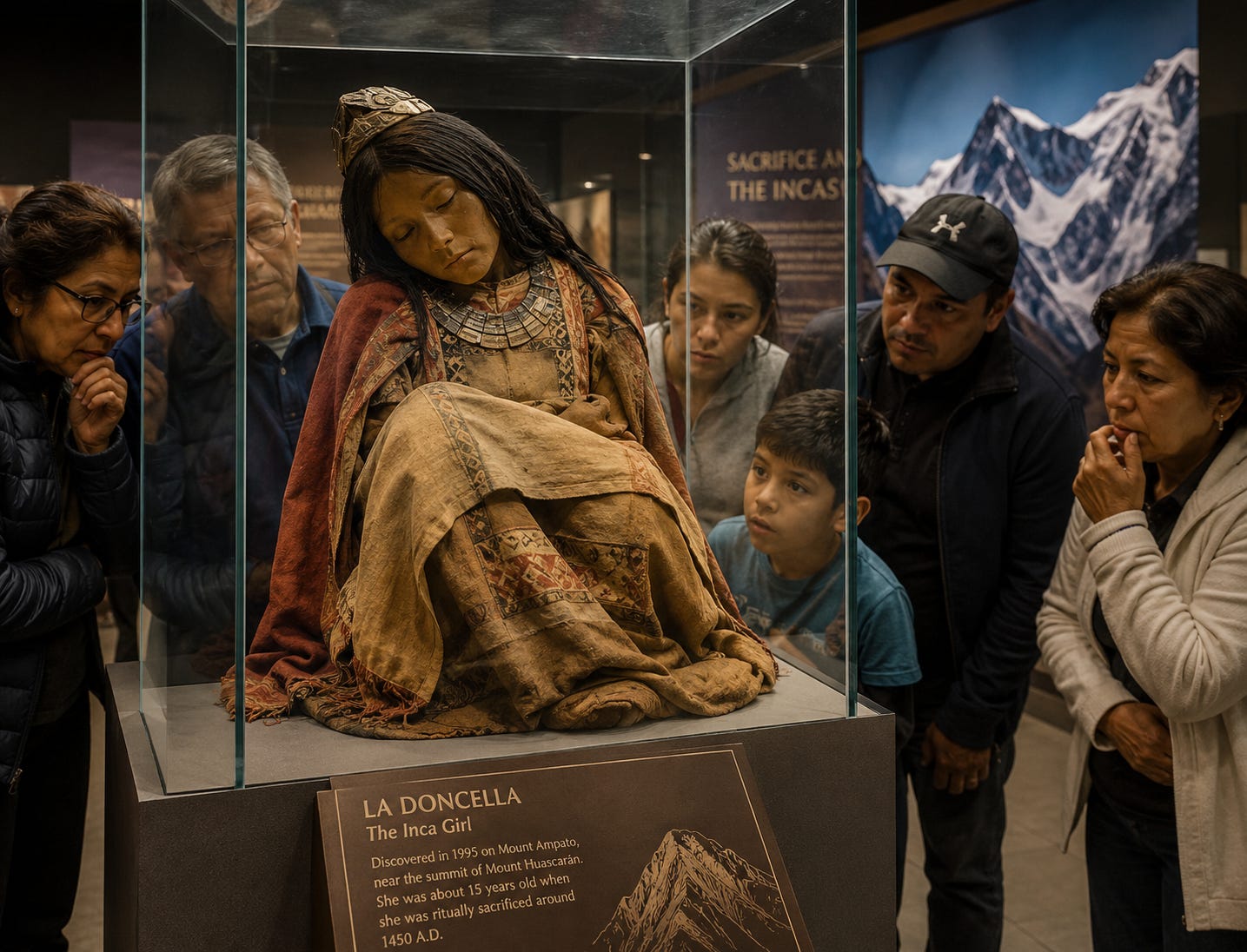
Yet, what was I being drawn towards?
“She” no longer existed—only her form.
I imagined making the journey to that museum to stand before her. Not to study her, as the scientists were doing, but to ponder what makes it possible for this human form to appear, to live, to grow, and to “die”?
Somehow, I felt at one with this stranger’s form, as though I were sitting beside her in that glass chamber.
I experienced a slight feeling of disorientation, as though I were frozen in time, everything narrowing to that one moment projected back to me through my phone.
I found myself asking: What happened to this young girl when her physical body froze to death?
Where did she go, or not go?
We’ve progressed rapidly in the West since the introduction of Enlightenment thinking and science.
We understand far more than previous generations about how our bodies work, how diseases spread and are cured, how the universe expands, and how the human form evolved over thousands and thousands of years.
And yet, when it comes to the question of where we came from and where we are going, we are still incapable of answering it with conviction.
Isn’t that odd? Isn’t it strange?
Why is human life like that?
Why isn’t a clear answer available to us?
Would our lives be any better off if we had a convincing, universally accepted answer to this question?
Or would it not matter one iota?